Advanced packaging requires integrated cooling at the semiconductor level // TRUMPF uses ultrashort-pulse lasers to enable the industrial production of the microstructures needed for this // Ultra-fine structures are created directly within the chip stack
Semicon Taiwan: TRUMPF Enables Integrated Chip Cooling for the Next Generation of AI Chips
Ditzingen/Taipei, 01 September 2026 – The next generation of high-performance AI chips requires new cooling solutions. At Semicon Taiwan, TRUMPF is showcasing for the first time a new ultrashort-pulse laser application that enables the industrial production of cooling systems integrated into AI chips. “Heat dissipation will become the bottleneck for future AI processors. Without new cooling concepts, the high requirements cannot be met. Our ultrashort-pulse lasers enable the cost-effective production of the microstructures required for this on an industrial scale,” says Cathrin Conrad, Business Development Manager at TRUMPF and responsible for chip cooling. With the new laser application, chip manufacturers can flexibly integrate cooling structures into the chip stack. The process is suitable for various materials, such as silicon carbide and diamond.
AI Boom drives demand for new cooling concepts
Manufacturers are increasingly turning to advanced packaging, a cutting-edge semiconductor technology in which chips are stacked or closely interconnected to enable greater computing power in a small space. As a result, heat is increasingly generated inside the chip stack and can only be dissipated to a limited extent using conventional cooling methods, such as cooling server racks or entire data centers. Leading semiconductor manufacturers have therefore included novel cooling solutions for chips in their development roadmaps, such as microfluidic cooling or heat spreaders. This involves incorporating extremely fine structures into the chip package that dissipate heat where it is generated.
Semiconductor manufacturers must integrate these cooling structures into materials such as silicon carbide. This material is suitable for demanding applications in the semiconductor industry and efficiently dissipates heat. However, manufacturing the required microstructures poses major challenges for the semiconductor industry, as silicon carbide is extremely hard, the required structures are extremely small, and they are difficult to produce using established etching processes.
TRUMPF lasers enable industrial production of cooling structures
This is where TRUMPF’s ultrashort-pulse lasers (USP) come into play. “The key advantage of our technology: It is the combination of high laser power, beam-shaping technology, and our many years of application expertise that makes the industrial production of integrated cooling systems in chip stacks possible,” says Conrad.
The USP lasers ablate the silicon carbide with micrometer precision and create the fine structures. High precision is crucial for reliable cooling. Compared to etching, ultrashort-pulse lasers enable at least five times the processing speed while delivering excellent surface quality and precise geometry of the cooling structures. This allows the semiconductor industry’s requirements for both quality and cost-effectiveness to be met simultaneously. After all, in addition to quality, productivity plays a central role for chip manufacturers.
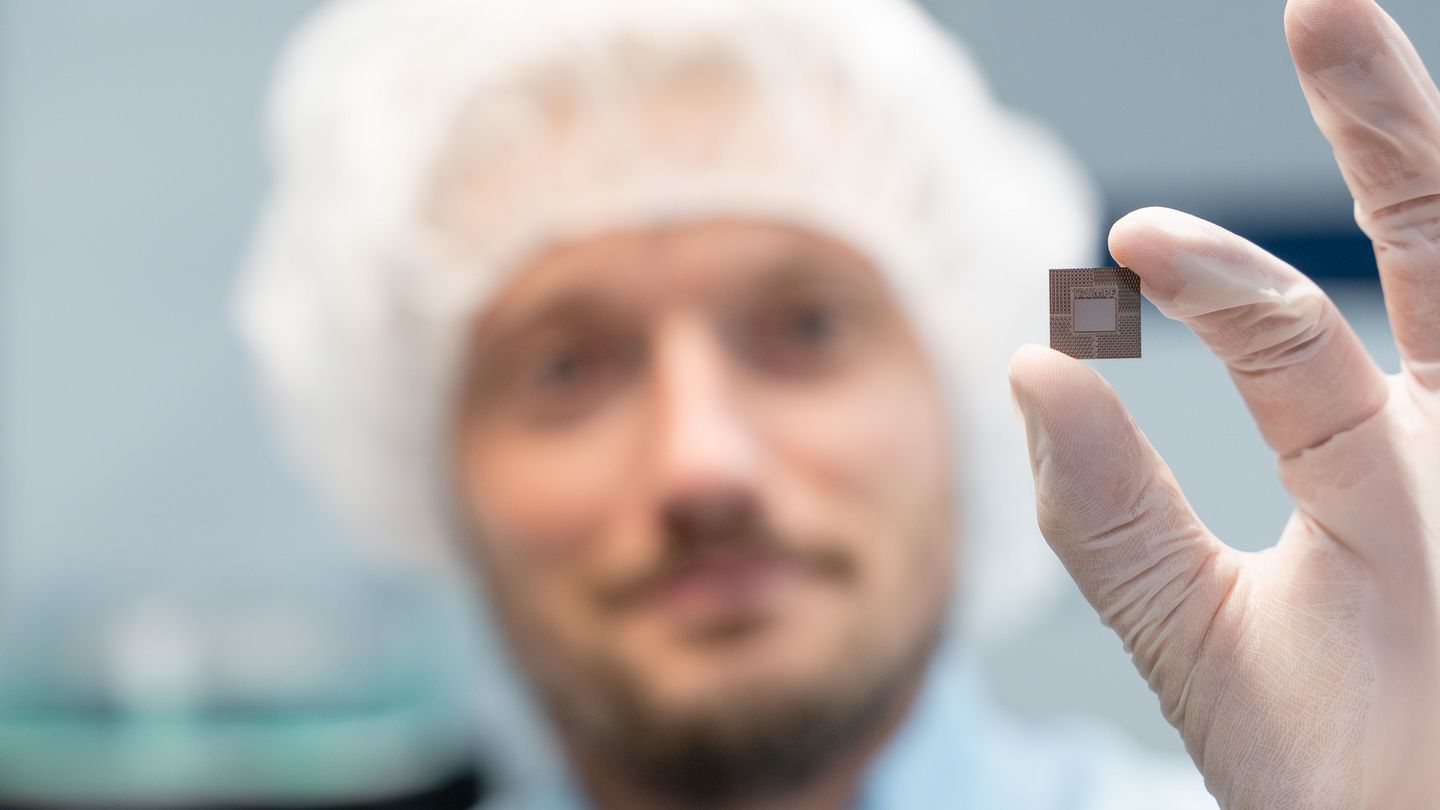
Chip with an integrated cooling structure
A TRUMPF employee presents a microchip with an integrated cooling structure. (Photo: TRUMPF)

Quality Control
A TRUMPF employee checks the quality of the microchip's cooling structures. (Photo: TRUMPF)
이 보도 정보에는 인쇄 가능한 해상도로 일치하는 디지털 이미지가 제공됩니다. 이는 편집 목적으로만 사용될 수 있습니다. 출처가 "사진: TRUMPF"인 경우 이용은 무료입니다. 메인 모티브 자르기를 제외한 그래픽 변경은 허용되지 않습니다. 추가 사진은 TRUMPF Media Pool에서 보실 수 있습니다.

A TRUMPF employee presents a microchip with an integrated cooling structure. (Photo: TRUMPF)

A TRUMPF employee checks the quality of the microchip's cooling structures. (Photo: TRUMPF)


담당자 이름