Ever stroked a shark? From a tactile perspective, it’s a rough experience. The reason lies in its scale armor made up of microscopically grooved shark scales. It may not look glamorous, but from a fluid dynamics standpoint it offers clear advantages. The grooves create a microstructure that significantly reduces energy-draining water vortices along the body. This allows the predator to cut through the water at speeds of more than 70 kilometers per hour – less drag, less energy consumption, higher speed.
DIRECTLY IN THE PAINT
Michiel Top has never touched shark skin himself. But he plans to process aircraft components with a similar structure soon. Together with nine colleagues, he works as a product developer at laser system manufacturer 4Jet on the LEAF project. The goal is to turn the aircraft’s surface itself into shark skin. What works in water also works in air. Here, too, microstructures can reduce energy consumption – in other words kerosene. Some airlines already use adhesive films with such structures. 4Jet is also developing these films but sees a better long-term solution. Michiel Top explains: “We introduce small V-shaped grooves, known as riblets, directly into the paint. This allows us to reduce friction drag by up to ten percent. That accounts for about 50 percent of total drag in an aircraft. In other words, if we structure the entire aircraft, we can achieve fuel savings of three to four percent on every single flight.” On average, an aircraft is in service for around 20 years and typically requires repainting every seven years. Over its service life, the savings in fuel and CO2 emissions are therefore substantial.
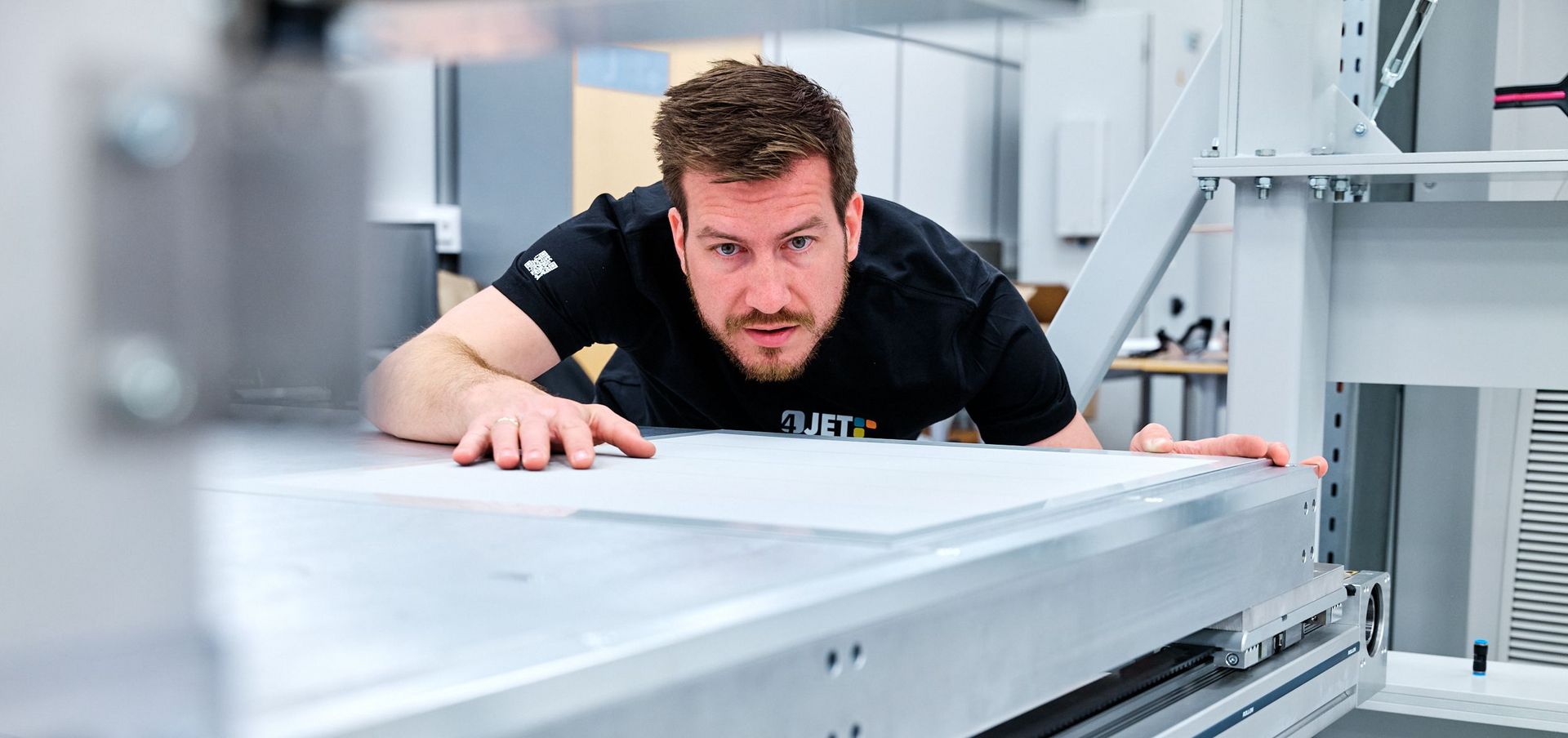
Two laser beams interfere with each other, causing tiny V-shaped grooves to form on the surface that are barely visible to the naked eye.
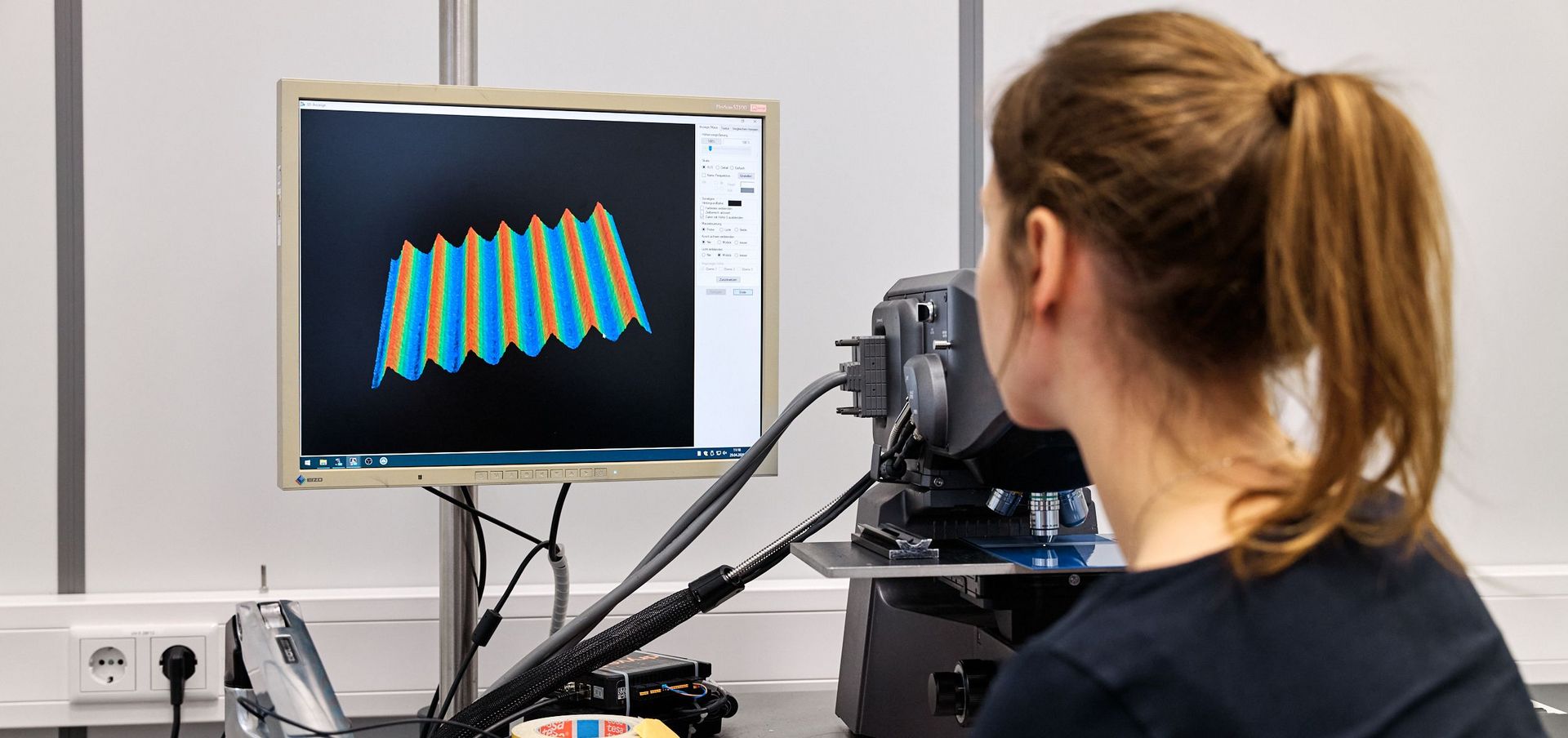
To ensure that even aircraft surfaces that are not perfectly flat can be reliably textured, 4Jet selects an exceptionally high depth of field.
V-shaped grooves, known as “riblets,” are incorporated directly into the paint. They reduce overall drag by 50 percent, resulting in enormous fuel savings.
SMALL RIBLETS IN LANES
So why use films that add weight and ultimately become waste? Because until now there has been no way to equip many hundreds of square meters of aircraft paint with a functionally optimized microstructure in a manageable time frame. It can’t be done. Or so it seemed. The LEAF team at 4Jet sees it differently: Can’t be done? Think again. LEAF stands for Laser Enhanced Air Flow. The project has been running for ten years and pursues an ambitious idea. The process uses the physical phenomenon of laser interference to structure surfaces. Using a special optical setup, 4Jet splits the laser beam and then recombines it so that the beams overlap and interact. This interaction creates a characteristic pattern of varying intensities, allowing surfaces to be modified on a microscopic scale.
At 4Jet, Lukas May is responsible for the LEAF system. He explains: “We generate a texture of riblets that are 100 micrometers wide and 50 micrometers deep. We apply this extremely fine microstructure evenly across an aircraft wing with an area of around 400 square meters.” The paint is therefore not processed point by point but in larger paths: With the laser, the system structures strips about 15 to 20 centimeters wide. Within these so-called lanes, a fully homogeneous riblet structure is created.
At the transitions, there are offsets in the millimeter range, but across the full surface these are functionally negligible, says May: “Otherwise we would have to structure a riblet twice, and that carries the risk of penetrating too deeply into the material. So we play it safe. We can still effectively place nearly 2,000 riblets side by side, then there is a seam that is not quite perfect.” Compared to conventional laser structuring, the relatively large depth of focus of around 20 millimeters ensures reliable processing even on slightly uneven aircraft surfaces – at speeds of up to one square meter per minute.
CO2 LASER VS CO2 CONSUMPTION
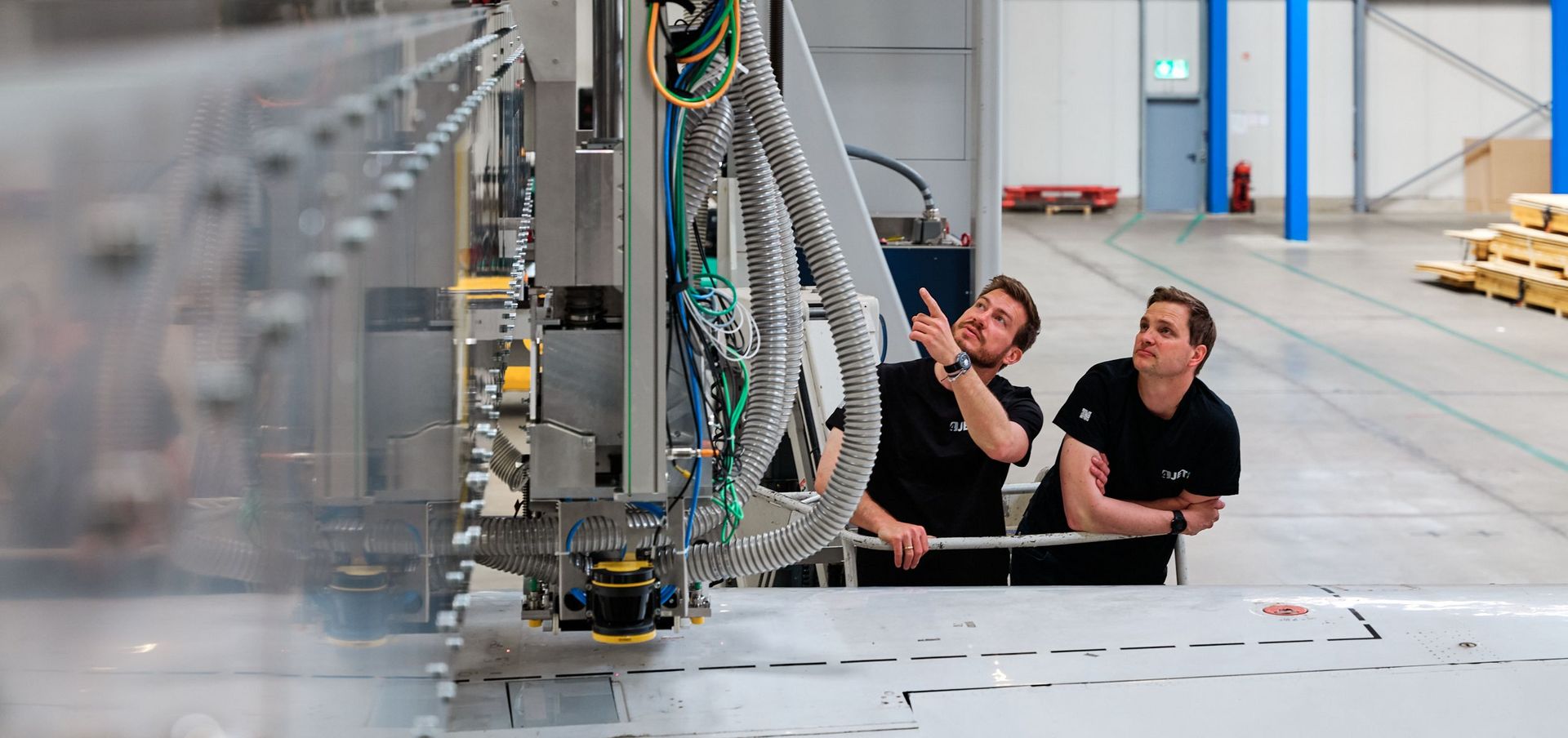
To make this approach work on large aircraft in a hangar, a flexible system is needed to guide the laser over the aircraft body. 4Jet has developed a portal system for this purpose. Its dimensions are enormous: The demonstrator in the company’s Alsdorf facility is ten meters high and 20 meters wide – designed to process the wings of an Airbus A330 or a Boeing 777. The system consists of a motion system, laser, mirrors, interference optics as well as sensors and software. The beam source is the CO2 laser TruFlow 5000. It best meets the physical requirements of the process.
Michiel Top explains: “The wavelength is crucial. The CO2 laser is very well absorbed by aircraft paint, enabling precise and material-friendly structuring.” At the same time, the laser must have high coherence so that the required interference pattern formed by overlapping beams remains stable. For this purpose, TRUMPF adapted the TruFlow for use at 4Jet, including spectral narrowing of the beam using a special grating. “With a CO2 laser, however, we cannot use an optical fiber,” May adds.
Due to the size of the portal, the beam path to the aircraft surface is long. A specially developed mirror system directs it to its destination. “The system itself twists, which is why we use active tracking. These are movable mirrors that are continuously adjusted.” Despite its size, the system is mobile. A safety laser scanner detects the exact position of both the aircraft and the system.
In principle, the riblet structure could be applied to the entire aircraft. In practice, however, 4Jet focuses on aerodynamically critical areas. Calculations show that the effect is greatest on the wings – where air friction plays the biggest role. Potential customers such as airlines are enthusiastic about the process, Top says. But it may take some time before the LEAF team coats their aircraft with shark skin. “We are currently looking for partners in the aviation industry who want to offer this service together with us,” May explains. Certification by the relevant aviation authorities is also required. And that takes time. May and Top remain confident: “We know it will take another three to four years before this is commercially airborne. But we have shown that our process works. Now we are ready for the next step.”