
High-precision fiber lasers play a pivotal role in the transition toward carbon-neutral mobility. The world needs zero-emission powertrains for everything from construction equipment, trucks and cars to trains, ships and eventually even aircraft. Based in Dettingen an der Erms in southern Germany, EKPO Fuel Cell Technologies is committed to providing the fuel cell technology that will drive this mobility transition and provide clean power. The company – a joint venture between automotive suppliers ElringKlinger and OPmobility, whose former name contributed to the acronym EKPO – has set the bar high: Rather than playing a background role, it aims to set the global standard for the entire fuel cell industry. A critical part of this mission is the ability to weld ultra-high-precision, gastight seams by the meter – a task perfectly suited to fiber lasers.
A single flaw equals failure
Holding a bipolar plate in his hand, Arno Bayer, Head of Industrial Engineering Joining at EKPO, explains the vital functions that bipolar plates perform in every fuel cell: connecting, distributing, conducting and cooling. Each plate consists of two ultrathin metal layers, typically just 75 to 100 micrometers thick, welded together in such a way that coolant can flow between them. Bayer points to a multitude of channel structures stamped into both sides of the plate: On one side of the finished product, hydrogen will flow; on the other, air (i.e., the oxygen required for the reaction). “Bipolar plates require a tremendous amount of expertise,” Bayer says. “But, at the same time, they have to be mass produced. We need up to 400 plates per fuel cell, which are then assembled into what we call stacks,” he explains, gesturing toward the completed fuel cells at the back of the EKPO facility, each roughly the size of a beverage crate. “The real challenge is making sure that every single seam on the bipolar plates is welded with absolute precision to be completely gastight. If even one plate leaks, then the entire stack – the whole fuel cell – fails.”

Arno Bayer (left) relies on TRUMPF fiber lasers. They meet EKPO's high requirements: ultra-fine, reliably gas-tight, and extremely fast welding.

Up to 400 bipolar plates are stacked alternately with membrane assemblies to form a fuel cell.
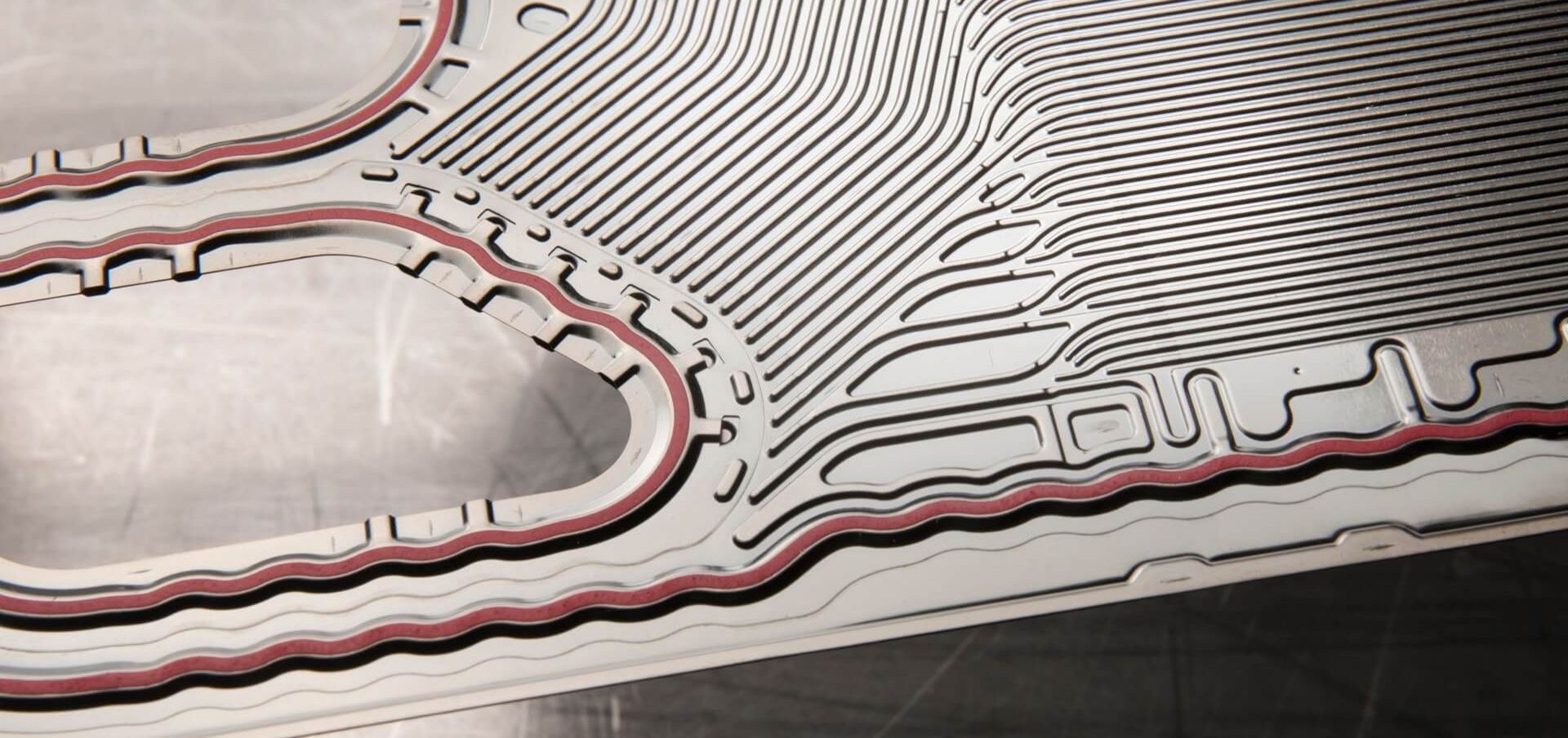
Hydrogen and oxygen flow through the tiny channels in the plates.
12,000 kilometers a year
EKPO therefore needs a laser that can weld high-precision, reliably gastight seams at lightning speed. In this case, lightning speed means operating near the so-called humping limit, the maximum welding speed achievable before undesirable bead-like humps start to appear on the seam for physical reasons. The weld seam is 0.1 millimeters wide and roughly 0.15 millimeters deep, and each bipolar plate requires a seam about three meters long. This means the laser at the Dettingen facility must lay down approximately 12,000 kilometers of weld a year – the equivalent of sailing from Hamburg to New York and back. “A single-mode fiber laser is the only laser in the world that we can rely on to get the job done,” says Bayer. “That’s why we chose the TruFiber, because its beam quality and process reliability are second to none.” Following successful welding trials and the development of an innovative clamping and handling system for the bipolar plates, EKPO decided to build a high-throughput production line. First, the laser fuses the two halves of each bipolar plate into a single, gastight unit. Next comes rigorous conductivity and leak testing, before the bipolar plate is ready for stacking – and ready to power the mobility revolution.


