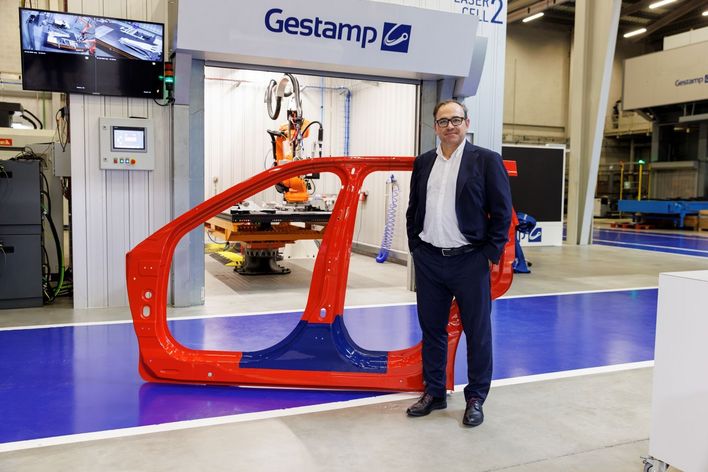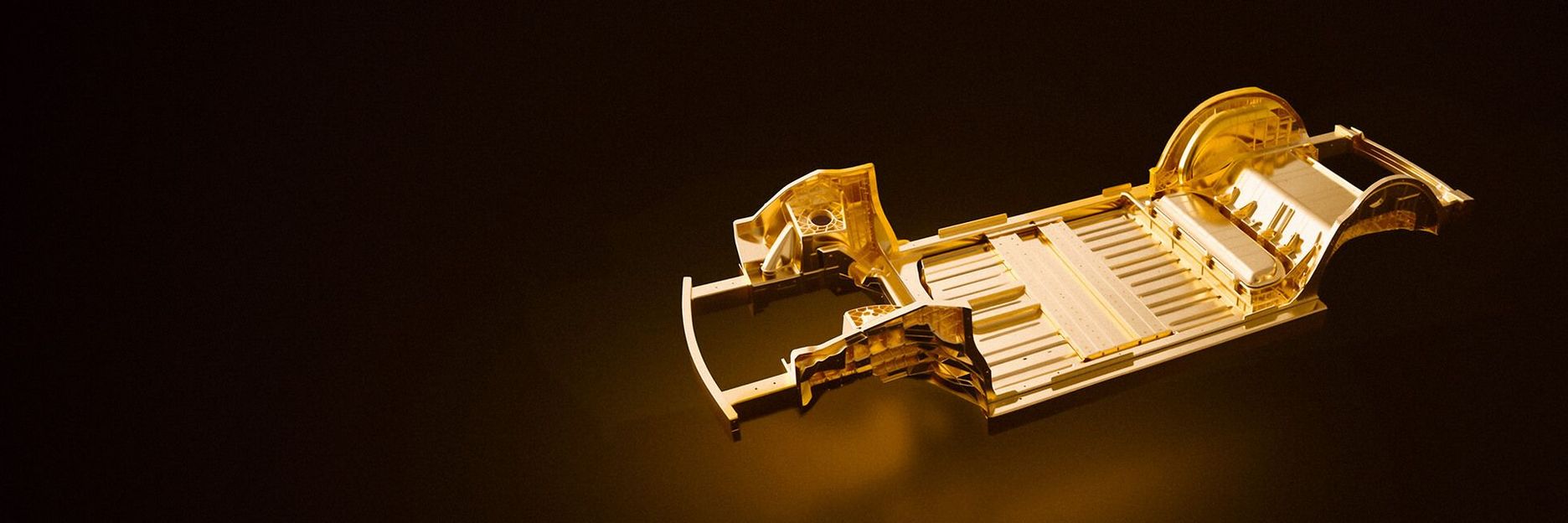
Gigacasting: a manufacturing technology in which a single solid aluminium mould replaces a hundred or more single parts. This not only saves time – assembly takes just 90 to 120 seconds instead of 45 minutes – but also reduces costs, material and weight. The automotive industry makes extensive use of this technology to manufacture vehicle components more easily and cost-effectively, especially in electric vehicles, where every kilogram counts. But the finishing process is complex: excess material must be removed, burrs must be taken off and surfaces must be cleaned – and all of this has to be done on a large scale, reliably and quickly. This is where the laser comes into play with four specialised solutions.
Overview of 4 post-processing solutions
Degating – Removing projections:
When the die-cast part emerges from the mould and the quenching tank, there are still 10 to 30 odd-looking structures protruding from its outer contours: thin spindles with feet attached, or flat discs – usually referred to simply as "gates" in technical jargon. This consists of solidified aluminium in the feed channels leading to the mould, with a thickness of two to six millimetres. The first step in post-processing is to remove these rough remnants.
Laser solution: Light from high-power lasers with six or more kilowattscuts away the projections. Thanks to the high kilowatt output, the cut is extremely precise, yet it is completed so quickly that only a minimal amount of heat penetrates the aluminium component, preventing it from deforming. On the production line, this task is performed either by six-axis robots equipped with optics for remote cutting or by a cutting head in a laser cell with a rotary table.
Deburring & hole-making:
No matter how high the clamping force of the casting machine may be, the molten aluminium still seeps into the tiniest gaps where the two halves of the mould meet. Paper-thin, sharp-edged burrs form, which can reach a total length of eight metres. In addition, the components require dozens of holes and recesses for later assembly.
Laser solution: Lasers located in the processing cell or guided by a robot via a scanner trace the contours and remove all excess material. In this type of precision work, high beam brilliance is more important for achieving an optimal ratio between processing speed and quality than sheer laser power. Laser beams with a brilliance of two BPP (Beam Parameter Product) remove burrs and cut mounting holes with millimetre precision.
Marking (traceability, Data Matrix Code):
Since gigacasting often replaces hundreds of small components with a single large component, achieving first-rate traceability is actually quite straightforward. A single Data Matrix code is all it takes for Smart Factories to link an individual component to a database containing all the key parameters of the casting process (vacuum pressure, flow rate, clamping force achieved, etc.).
Laser solution: Marking stationscan be integrated at various points in the process chain. A pulsed, scanner-guided laser beam creates a high-contrast marking on the aluminium surface. It can be read by cameras and can provide processing information to robots and machines further down the process chain.
Surface treatment:
Cast aluminium components have various types of contamination on their surfaces: residues of the release agent from the casting mould (oils and fluids), as well as casting powder or smoke residue. In addition, an oxide layer forms quickly on aluminium. All of this affects the assembly steps in the downstream process chain, such as welding, bonding, and sealing.
Laser solution: Scanner-guided short-pulse lasers precisely clean the relevant joints: Oxide and contaminants evaporate and are extracted. But that's not all: when set to the correct parameters, the laser pulses homogenise the crystalline structure of the surface at a microscopic level in preparation for subsequent sealing – no more crevice corrosion; joining becomes easier and the quality is higher. To prepare the surface for bonding, the laser also creates a slight texture. This little trick increases the specific surface area and greatly improves both the wetting behavior and the adhesive strength.