Have you ever petted a shark? To the touch, it's quite rough. The reason for this is its sequined dress made from specially grooved, microscopic shark scales. It doesn't look particularly glamorous, but it offers the shark clear advantages in terms of hydrodynamics. The grooves in the shark's scales create a microstructure that significantly reduces energy-consuming water vortices along its body. It enables the predatory fish to dart through the water at more than 70 kilometres per hour: less drag, less energy consumption, higher speed.
Directly onto the paintwork
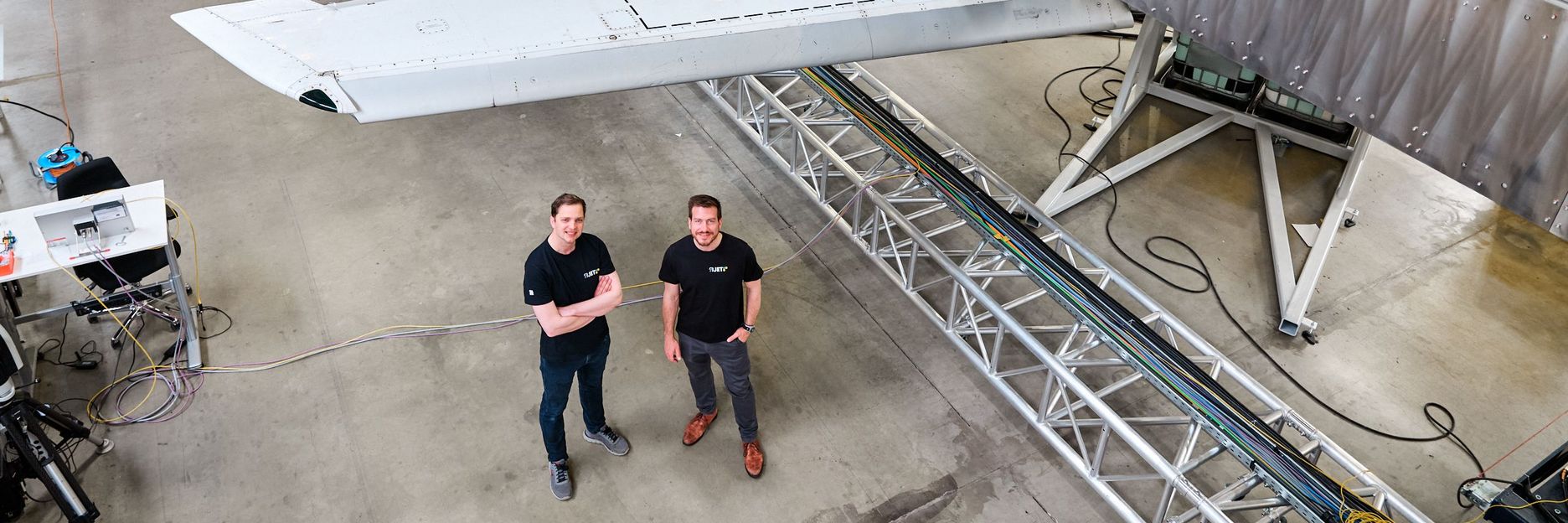
Michiel Top has never touched a shark's skin himself. But he plans to apply this type of structure to aircraft parts very soon. Together with nine colleagues, he works as a product developer at the laser systems manufacturer 4Jet on the LEAF project. The aim is to turn the aircraft's skin into shark skin. After all, what works in water also works in the air. There, too, energy consumption – that is, kerosene – can be reduced using microstructures. For this reason, some airlines are already using pre-assembled structures. 4Jet also develops this type of film, but believes there is a better way in the long term. Michiel Top explains: "We incorporate the small, V-shaped grooves known as riblets directly into the paint." This allows us to reduce frictional resistance by up to 10%. In an aircraft, this accounts for about 50% of the total drag. That means that if we redesign the entire aircraft, we'll achieve fuel savings of 3 to 4% on every single flight." On average, an airplane remains in service for about 20 years; it typically needs to be repainted every seven years, so when calculated over its entire lifespan , the savings in fuel and carbon emissions are enormous.
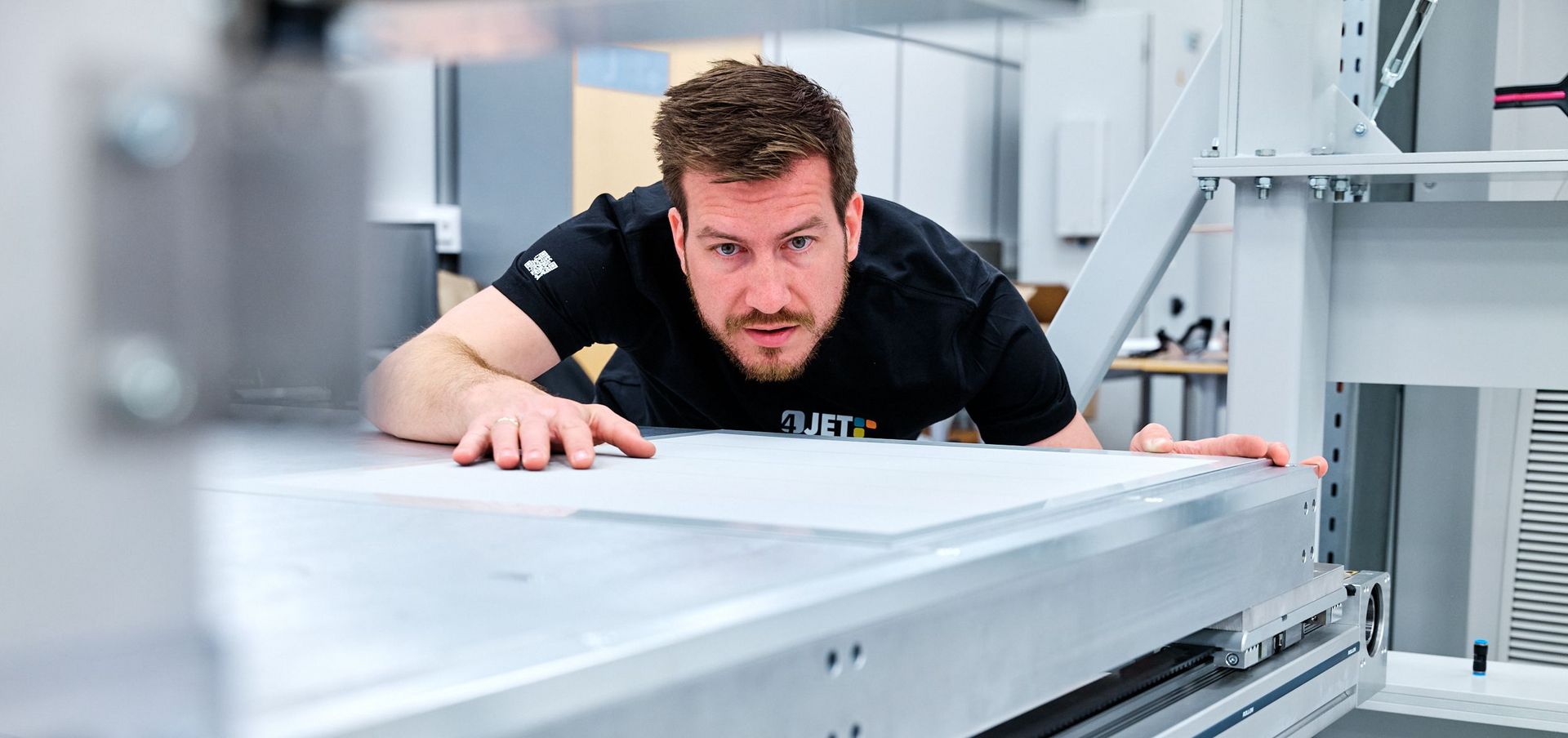
Two laser beams interfere with each other, causing tiny V-shaped grooves to form on the surface that are barely visible to the naked eye.
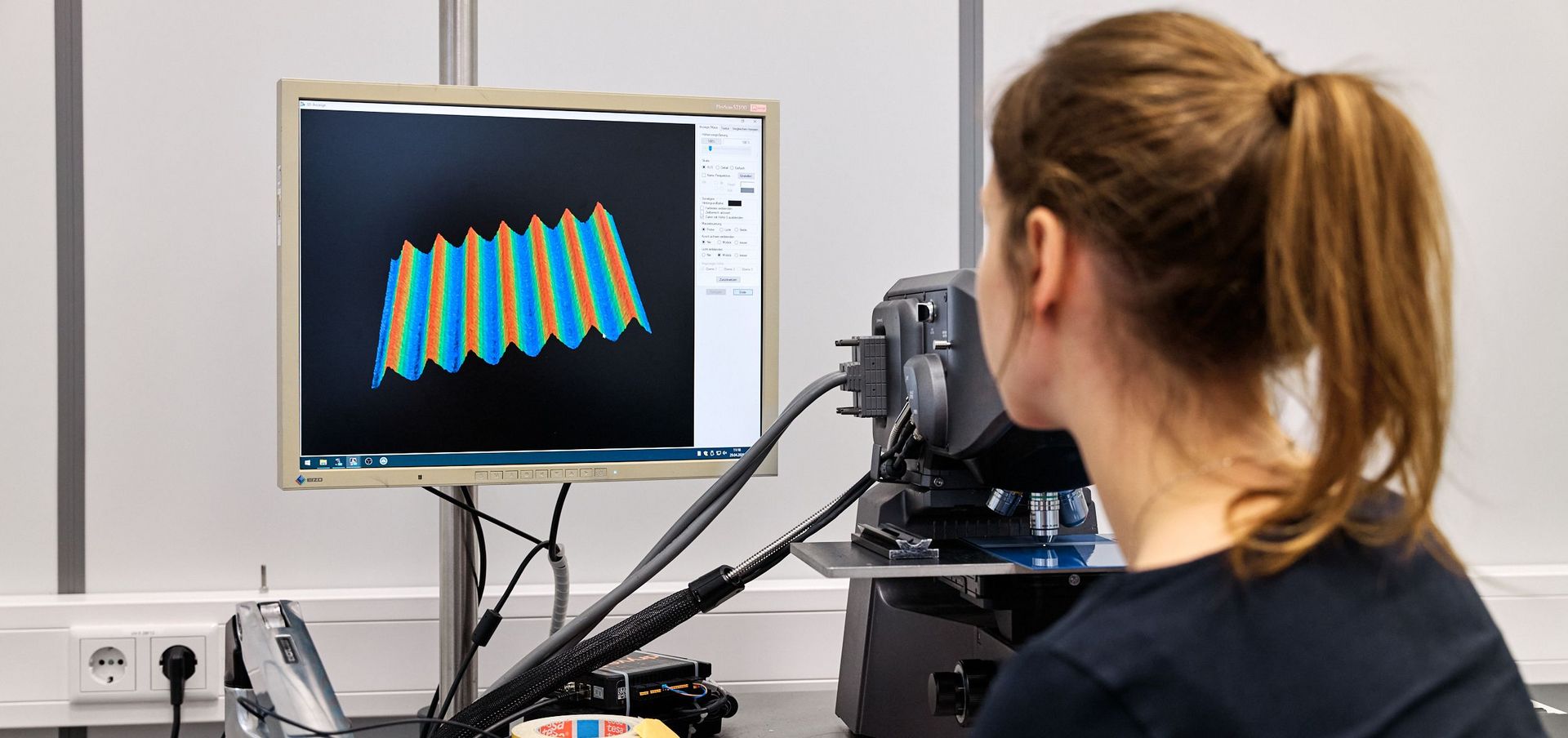
To ensure that even aircraft surfaces that are not perfectly flat can be reliably textured, 4Jet selects an exceptionally high depth of field.
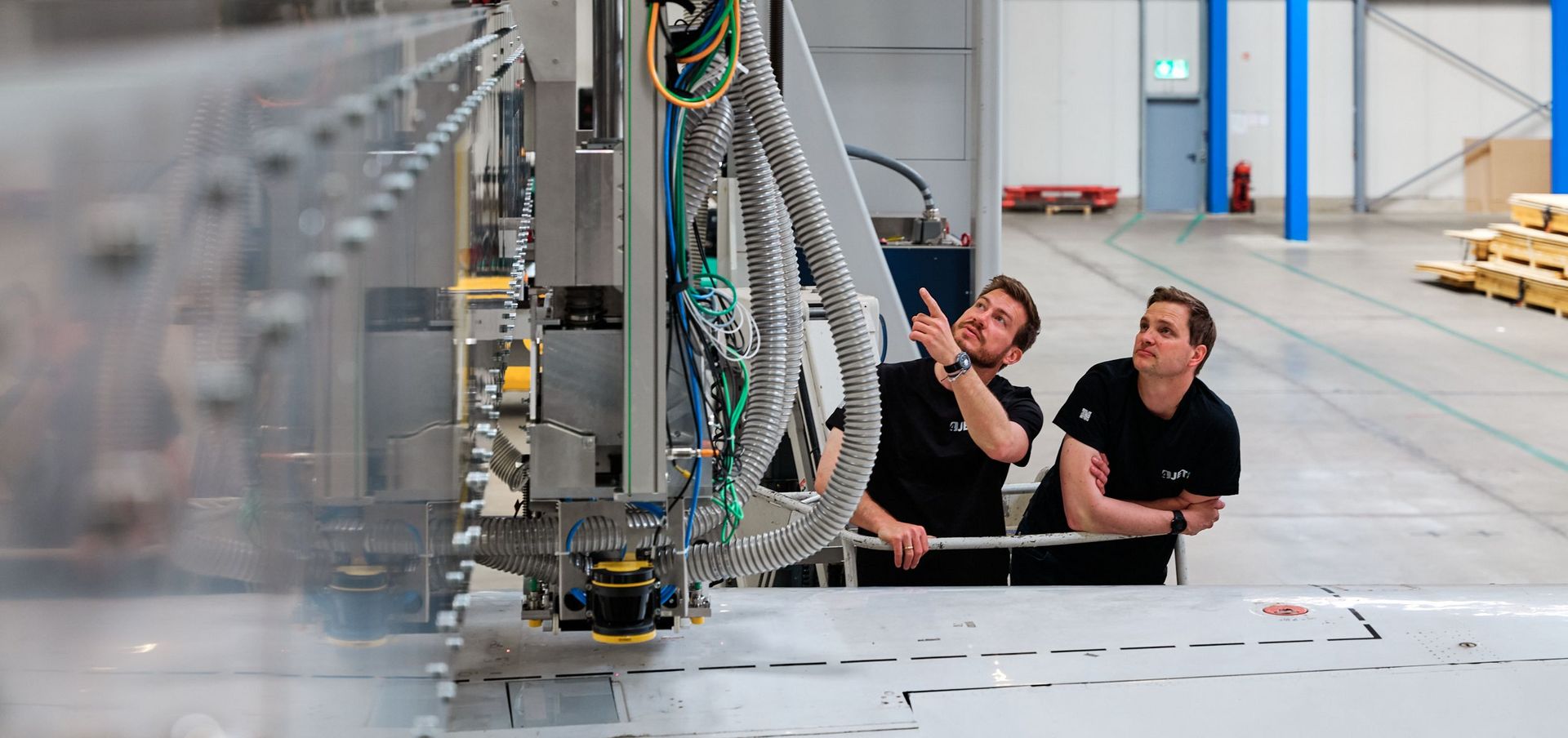
V-shaped grooves, known as riblets, are incorporated directly into the paint. They reduce overall drag by 50%, resulting in enormous fuel savings.
Small riblets in strips
So why use the film, which adds weight to the aeroplane and ends up as rubbish? Because, to this day, there is no way of applying a microstructure that is perfectly optimised for functionality to several hundred square metres of aircraft paint within a reasonable timeframe. It doesn't work. It doesn't exist. End of story. The LEAF team at 4Jet puts it differently: It can't be done?" No way! Exclamation mark. LEAF stands for Laser Enhanced Air Flow. The project has been around for ten years and is based on an ambitious concept. The process uses the physical phenomenon of laser interference to pattern surfaces. Using special optics, 4Jet splits the laser beam and then recombines it so that the two beams overlap and interact with each other. This interaction produces a characteristic pattern of varying intensities. This makes it possible to modify surfaces on a microscopic scale.
Lukas May heads up the LEAF system at 4Jet. He explains: "We create a texture consisting of riblets that are 100 micrometers wide and 50 micrometers deep." "We apply this ultra-fine microstructure evenly across an aircraft wing with a surface area of just over 400 square metres." The coating is therefore not processed point by point, but in larger swaths. Using a laser, the system creates strips approximately 15 to 20 centimetres wide at a time. A completely homogeneous riblet structure forms within these "lanes".
There are misalignments of a few millimetres at the junctions, but these are not functionally critical when viewed over the large surface area, says May: "Otherwise, we would have to go through a riblet twice, and there is a risk that we would create a pattern too deeply in the material." That's why we're playing it safe. Even so, we can effectively place nearly 2,000 riblets side by side, but then we end up with a seam that isn’t quite perfect." The very large depth of field - around 20 millimeters - compared to conventional laser structuring ensures that the process works reliably even on aircraft surfaces that aren't perfectly flat, at speeds of up to one square metre per minute.
CO2 lasers vs. CO2 consumption
To ensure that this process works even on large aircraft in the hangar, a flexible system is needed that guides the lasers over the fuselage. 4Jet has built a gantry for this purpose. Its dimensions are enormous: the demonstrator, which is on display in the hall at the company's headquarters in Alsdorf, is 10 metres high and 20 metres wide. Designed to process the wings of an Airbus A330 or a Boeing 777. The system consists of a motion system, lasers, mirrors, interference optics, sensor systems and software. The light source is the CO2 laser TruFlow 5000. It best meets the physical requirements of the process.
Michiel Top explains: "The wavelength is crucial – the CO2 laser is absorbed particularly well by aircraft paint, enabling precise texturing that is gentle on the material." At the same time, the laser must have high coherence so that the necessary interference pattern – created by the overlapping laser beams – can form stably. TRUMPF therefore adapted the TruFlow for use with 4Jet, in part by narrowing the beam's spectral width using a special grating. "With the CO2 laser, however, we can't use an optical fiber," explains May.
Because of the size of the gantry, the beam has to travel a long way to reach the aircraft fuselage. A specially designed mirror system guides it there. "The system itself is subject to torsional stress, which is why we use active tracking. These are movable mirrors that can be adjusted as needed." Despite its size, the system can move freely. A laser scanner detects the exact position of the aircraft and the system.
In principle, the riblet structure could also be applied to the entire aircraft. In practice, however, 4Jet focuses on the areas that are particularly relevant from an aerodynamic standpoint. Calculations show that the effect is greatest on the wings – where air resistance is a particularly significant factor. Potential customers, such as airlines, are enthusiastic about the process, Top says. But it will likely be a while before the LEAF team covers their aircraft with shark skin. "We are currently looking for partners in the aviation industry who would like to offer this service in collaboration with us," explains May. They will then need to obtain the necessary certifications from the relevant aviation authorities. That takes a lot of time. May and Top remain optimistic, however: "We know that it will still take three to four years before it's commercially available. But we have shown that our method works. Now we're ready for the next step."