Mr Postrigan, Mr Elmalem, on 24 February 2022, Russia invaded Ukraine and on 7 October 2023, Hamas attacked Israel. How do you each remember the day that would change your country and your life?
Yuri Postrigan: When Putin crossed the border, I thought that Ukraine would be done for within three days. I thought we didn't really have much of an army – no weapons, a population unprepared for war. Three of my six service engineers opted to go to the front. They are still fighting today. One of them was recently hit and wounded in an attack in Odessa, but fortunately he has recovered.
Arie Elmalem: Immediately after the Hamas attacks on 7 October 2023, the army called up three service technicians from our seven-person team. On the same day, we decided as a team that our customers should not feel any effect from the current events. The last few months have been extremely difficult. The last of the three service technicians returned from his assignment only two days ago.

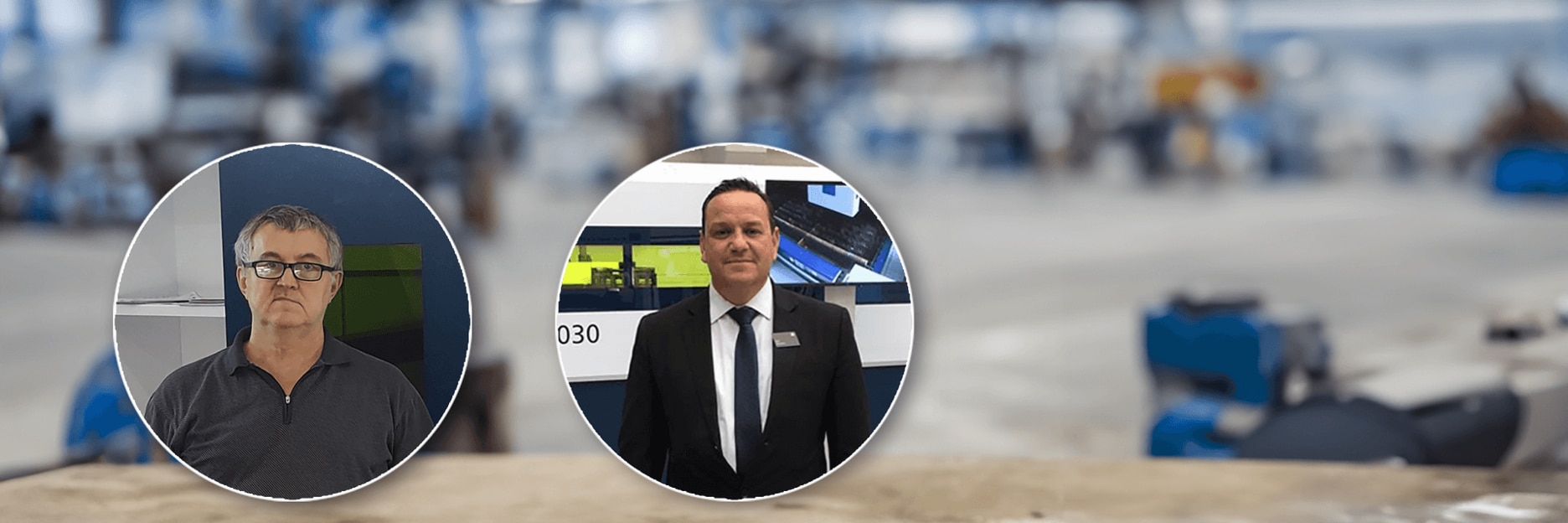
Yuri Postrigan, head of sales and service at TRUMPF in Ukraine

Arie Elmalem, head of sales and service at TRUMPF in Israel
What impact does the conflict have on your customers?
Arie Elmalem: In Israel, the affected area is located in the north and southwest on the border with the Gaza Strip. We have some customers in that area. They have managed to keep their operations going in recent months despite rocket fire. In the early days of the conflict, however, they suffered from a shortage of raw sheet metal for production because some of their suppliers initially stopped delivering there. Some employees were also absent because they had fled, so we had to train some of our customers' new employees to use TRUMPF machines. We also had to take on the commissioning of new machines, as TRUMPF can no longer send employees to these areas for security reasons.
Yuri Postrigan: Ukraine's industrial regions are mainly in the east of the country, which is exactly where the Russian incursion occurred. Many companies have moved their production to the west of the country. They have lost some of their workforce because the men are serving at the front, and some have fled the country.
What impact has the war had on your relationship with customers?
Yuri Postrigan: Even before the war, we always focused on the wishes of our customers. For instance, we never put them under pressure in negotiations. Compared to our competitors, we have always enjoyed a special, cooperative relationship. Despite this, they were occasionally critical of us even before the war, for instance if we weren't fast enough. Now it is clear to everyone that we are all in the same boat. When a problem crops up, we openly discuss how to find the best solution despite the adverse circumstances.
How is it in Israel?
Arie Elmalem: We stand united with our customers. We prioritise those who are affected by the war on a daily basis. These include, for example, a customer in a kibbutz on the border with the Gaza Strip. This place, Rahim, was attacked by terrorists, who killed some members of the kibbutz. The terrorists also came to our customer's sheet metal processing facility and started shooting.
Two weeks after the attack last October, my senior engineer and I received permission from the army authorities to travel there. When we arrived at the factory, the service manager was completely astounded, because he hadn't called us. We explained that we'd come to see what was going on. We had brought spare parts with us to get the machines going again.
How did other companies handle the situation?
Arie Elmalem: We offer an extremely high level of service. We have nine service engineers working for TRUMPF, while many of our competitors only have two. Our customers get used to it, and that's what makes the difference. We don't just show up when someone wants to buy a machine. We are there for our customers whenever they need us. We put a machine into operation on the border with Lebanon while the region was under missile fire. Our service technicians had to run to the air-raid shelter six or eight times a day. They only had a few seconds to get there each time due to the close proximity of Lebanon.
Yuri Postrigan: In Ukraine, some serious competitors have simply disappeared from the market. We have stayed.
What are your hopes for the future?
Yuri Postrigan: We find ourselves in a very difficult situation. If we could be given some preferential treatment by our global partners because of the war, that would be fantastic. We can take care of the rest.
Arie Elmalem: I hope that all employees and family members of our customers who are serving in the Israeli army or who have been taken hostage will return home safely. And I hope that we can all return to a normal life soon.