Let's start from the beginning. What exactly is plasma?
Strictly speaking, plasma is simply the fourth state of matter. If you keep adding more and more energy – such as heat – to a solid, it will first turn into a liquid and then into a gas. If you keep going now, you'll get plasma.
So how is plasma formed?
In a normal gas, the atomic nucleus and electrons are firmly bound together – the atom is electrically neutral and stable. However, if you increase the energy input to the gas, the atoms collide with such force that the binding forces weaken and the electrons are torn from their orbits. The gas transforms into a chaotic soup of particles consisting of freely moving, negatively charged electrons and positively charged atomic nuclei. The process by which plasma is formed is called ionization. In nature, this usually happens the hard way – either through unimaginable heat, such as in the sun's core, which reaches 15 million degrees, or through massive electrical discharges when a lightning strike ionizes air molecules with millions of volts.
How can plasma be produced artificially?
The industry controls plasma generation using precisely calibrated electricity in a high-tech facility – with workpieces placed in a vacuum chamber. A noble gas, such as argon, flows into the chamber. That's where the magic of plasma happens, inside the vacuum chamber. However, the truly technically challenging part takes place outside the chamber: Special generators, such as those manufactured by TRUMPF, convert standard line voltage into high-frequency or pulsed voltage and direct this energy straight into the gas in the vacuum. The electric field suddenly sweeps the electrons along, causing millions of collisions among them. And there you have it: plasma. The generator is the conductor here. It controls and balances current, voltage, and frequency in the millisecond range, precisely shaping the plasma to have the forms and properties required for the specific application – for example, for surface treatment or ultra-thin coating.
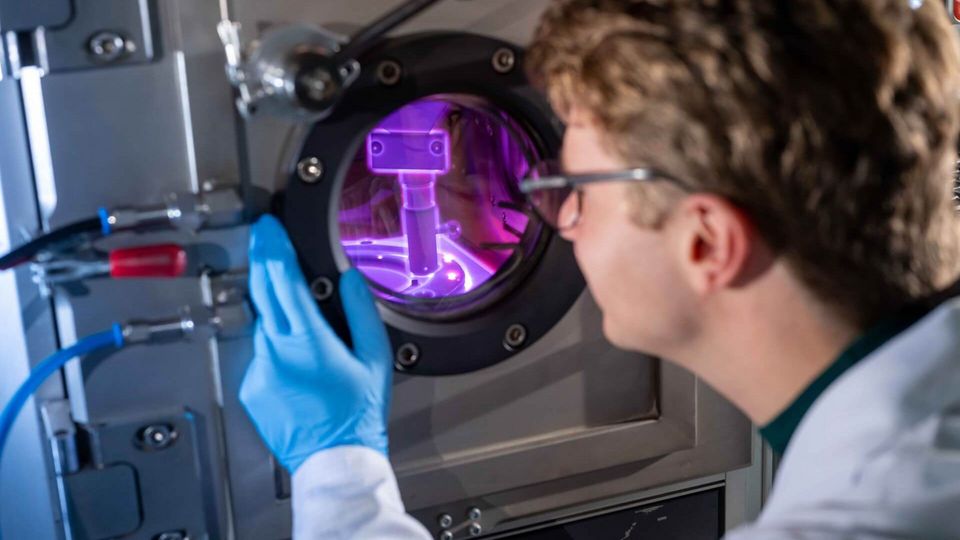
In this vacuum chamber, glowing plasma is generated for the coating process. However, it is the connected high-tech generator in the background that tackles the technical challenge.
What is it about plasma that the industry finds so great?
Although plasma is a turbulent mess in its natural state, under industrial conditions there is no other state of matter that can be tamed so easily and controlled so precisely – even down to the atomic level. This is because plasma is an extremely good electrical conductor and is therefore highly sensitive to the electromagnetic fields generated by the special generator. These fields grasp the plasma like invisible tweezers, stretching or compressing it, accelerating it, or keeping it suspended in space. Secondly, plasma is highly chemically reactive. The free-floating ions are desperate to bond again and so attack any material that comes into contact with them. Industry uses plasma for many purposes – for example, for surface treatment of a wide variety of materials, such as hardening, or for sterilising heat-sensitive medical devices. Yet it is precisely the combination of its precisely controllable and highly reactive properties that makes plasma indispensable in microchip manufacturing.
What is plasma used for in chip manufacturing?
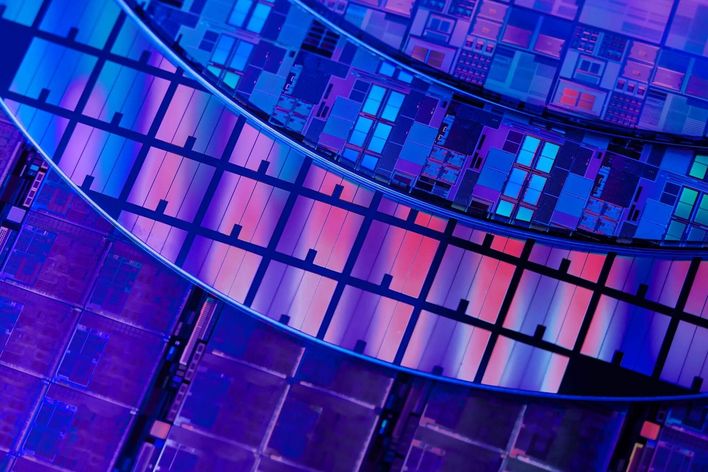
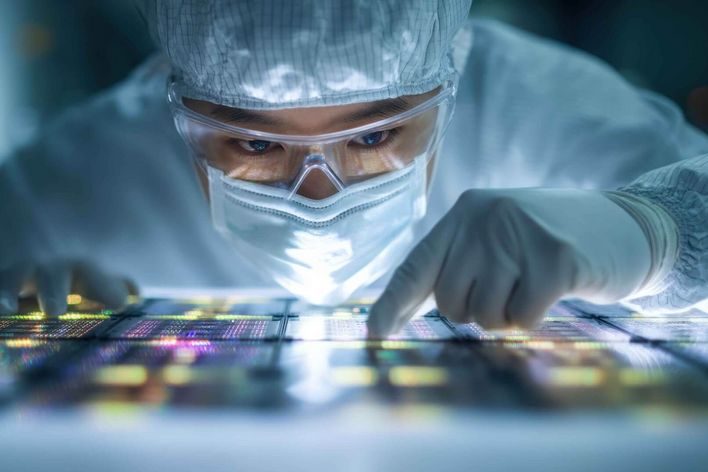
Microchips are built up layer by layer on silicon wafers, and the plasma tells the atoms where on the wafer they are allowed to be and where they are not. These days, billions of transistors are packed onto a piece of wafer the size of a fingernail. The dimensions are so tiny that you can’t use normal tools, so you have to resort to plasma. In practice, plasma performs two main functions – during etching, a targeted plasma spray acts like a sandblaster at the atomic level. It removes microscopically fine patterns, creating tiny circuit board structures. During the coating process, the plasma acts as a kind of "usher" for the atoms. Plasma causes gases to react to form specific surface layers on the wafer, or knocks atoms out of a piece of metal like billiard balls so that they are deposited on the wafer with atomic-layer precision to form an insulator or conductive track.
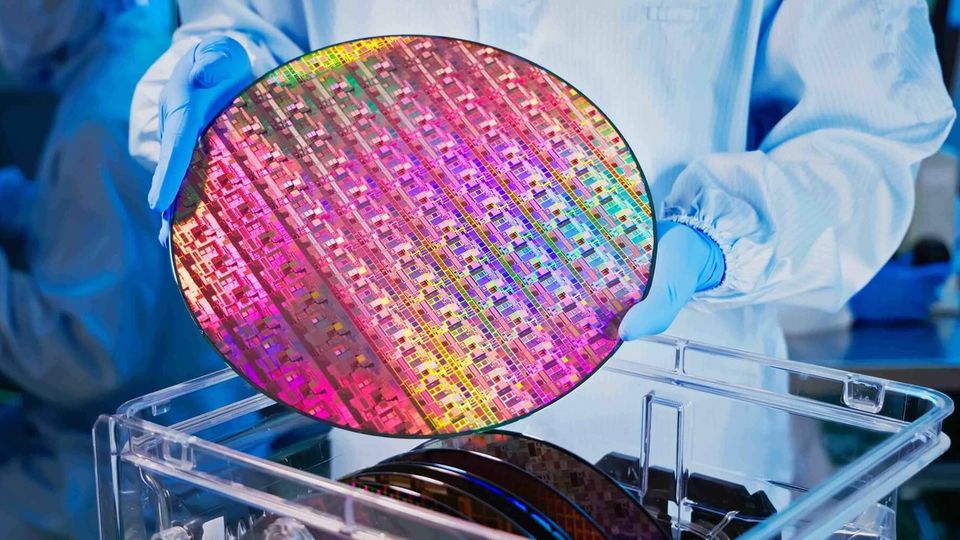
Microchips are manufactured layer by layer on these silicon wafers. Without plasma as a tool, this simply wouldn't work.
So what does plasma have to do with my mobile phone?
It's quite simple. Without plasma directed by generators, there would be no high-performance chips, which are used in virtually all advanced devices today. Without plasma, no one would have a PC; there would be no AI, no Internet, and no mobile phones.