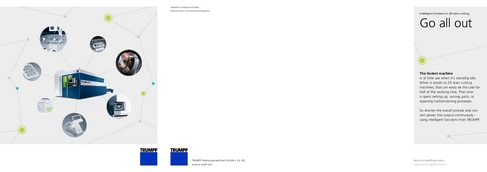
The machine of the future will cut autonomously – we are confident of that. Discover our vision for the autonomous TruLaser Center 7030 machine.
-
Autonomous laser cutting The machine of the future cuts autonomously – we're sure of that. We also know who will benefit the most from it: you. This is because our future technology is aware. It looks ahead. Works almost on its own. With the person in control at all times. This is only possibly through the interplay between intelligent assistance systems, adaptive machine functions and last but not least, ground-breaking ideas. Discover TRUMPF's vision for autonomous machines now, as well as our innovations which are already available now, and their potential for your sheet metal processing. Join us in the autonomous future. Much more than a vision: autonomous machines at TRUMPF We have laid the cornerstone for autonomous machines through numerous assistance systems. Progress is far from complete, and we are certain that the future belongs to autonomously working machines. They monitor and regulate the machining process, enabling a smooth production process. The operator is unburdened, and their role changes to that of a process manager. This collaboration between human and machine achieves optimal results. 5 stages to autonomous machines 1 UNASSISTED Manual monitoring Operator involvement at the machine Operator involvement is at a maximum. All tasks are completed by the operator. 2 ASSISTED Manual monitoring Operator involvement at the machine The machine supports the operator with selected tasks. The operator is primarily located around the machine. 3 SEMI-Autonomous Manual monitoring Operator involvement at the machine The matchine regulates the cut mostly on its own. Generally the operator has only to be by the machine at predictable points in time. 4 HIGHLY Autonomous Manual monitoring Operator involvement at the machine The machine prevents interruptions by self-optimization. The operator is informed about necessary interventions in advance. 5 fully autonomous Manual monitoring Operator involvement at the machine The machine reacts independantly to all interruptions in the production process. Operator involvement is kept to a minimum, the focus is on machine maintenance. Manual monitoring Operator involvement at the machine Our vision is clearly defined. We have our sights set on developing machines which operate autonomously. With the Active Speed Control system for adaptive feed control on the TruLaser Series 5000 or the TruLaser Center 7030 full-service laser machine, we have crossed the threshold to the third stage on the scale. The fifth stage is a fully autonomous machine. When it comes to classification, the following parameters are especially taken into account for location determination: proportion of manual monitoring and operator involvement at the machine. The focus lies on a machine's ability to recognise, prevent and resolve malfunctions independently – without human intervention. Our vision is for the operator to have a central role involving having control and managing the process. Products and functions The Active Speed Control system for adaptive feed control is an important milestone on the path to autonomous laser cutting. Numerous assistance systems are also available, which offer intelligent solutions for different process steps. Discover which parts of the vision are already a reality. Advantages for your laser processing The future of laser cutting is becoming simpler and less stressful. Read here to discover the advantages that integrating autonomous and partially autonomous technologies can offer for your 2D laser processing operation. Curious about the future of laser processing? What does autonomous laser cutting mean for your parts production? What benefits are there to you? Our 2D laser cutting experts would be happy to answer these as well as other questions. Large strides forward: intelligent sensor systems increase productivity Part of our vision for fully autonomous laser cutting is already a reality. Intelligent assistance systems for laser cutting develop execution strategies, for example, which prevent collisions with tilting parts, or make post-production of parts from remainder sheet easier. Even nozzles are automatically inspected and replaced if necessary. The proportion of machine functions which control processes independently is ever-increasing. An important milestone on the path to autonomous machines is the Active Speed Control system for adaptive feed control. The system monitors the kerf through the nozzle, oversees the cutting process and independently regulates feed speed. It ensures the right feed level for flame and fusion cutting, even in the event of thickness variations in a sheet, or if the sheet has been affected by quality fluctuations (i.e. rust or coating remnants). Data analysis makes quick and stable cutting possible. This can prevent disruptions to cutting and noticeably reduces the number of reject parts. The operator is also relieved. They can pull up the most important process parameters or a live-image through the nozzle any time, and will be actively informed if the need for intervention arises. Tapeshots which were necessary up to this point are now a thing of the past. Active Speed Control oversees the process, controls cutting How the Active Speed Control system for feed control works The cutting process is monitored in real time from above with a view through the cutting nozzle. The sensor system monitors the kerf, determines the optimum feed and adjusts it as required – many hundreds of times per second. This minimises cutting interruptions due to material differences such as variations in sheet thickness, rust or paint impurities. In the event of an impending cutting flaw, Active Speed Control ensures that the machine stops. In conjunction with Smart Rerun, the machine can automatically perform re-entry or switch to the next part. Active Speed Control also reduces the formation of burrs and slag. The minimised reject rate leads to lower part costs. How Active Speed Control performs when it comes to sheet metal Experience first-hand how Active Speed Control showcases its intelligence with sheets of 4 mm and above, through a direct comparison of sheet against sheet. Manual reduction of the feed is not required to compensate for differences in the material. Previously, when the user reduced the feed, this caused heat to accumulate in the material. This heat build-up causes uncontrollable melting of the material. Automatic feed control, on the other hand, prevents this increased heat development and so improves part quality at the same time. Feed rate significantly above default values Up until now, cutting data has informed a machine how a material of a certain sheet thickness should be processed. This process includes a buffer in the event that the quality of the sheet fluctuates, or if inexperienced operators had not optimally set it for the next order. This means the machine cuts at a lower feed rate than it can actually handle. Active Speed Control makes this buffer redundant. The sensor system allows the machine to work as quickly as possible, and with as much process reliability as necessary, respectively. Active Speed Control often achieves speeds which are noticeably higher than the default values contained in the cutting data. Comparison between laser cutting with and without feed control Cut contour without adaptive feed control Material bulging can be easily detected when flame cutting mild steel without Active Speed Control, because the cut was not clean in certain areas. Ultimately, the feed needed to be stopped entirely, as a cutting flaw had occurred. This results in faulty parts and rejects. Cut contour with adaptive feed control Active Speed Control creates a clean cut, largely without a large amount of spatter or spatter residue. Rust and surface contaminations lead to automatic control and adjustment of the cutting head feed. This allowed cutting flaws to be prevented effectively. Take a look behind the scenes TRUMPF is a pioneer in the laser cutting industry. To ensure we remain so in the future, we research tirelessly, always on the boundary of technological possibilities. We have a clear vision on the path to autonomous machines: to make the work of operators easier, through simple and sophisticated operating concepts. Our solutions give them the ability to respond to potential malfunctions with ease. The focus is on cost-effectiveness, as compared to non-assisted processing, the part costs for autonomous processes are significantly lower. Performance analysis: TRUMPF developers optimise the processing for all sheet thicknesses It just gets better – TRUMPF developers are evaluating cutting data in order to further optimise Active Speed Control Agile project planning: 2D laser development employees in a sprint review Electrifying: future technology arises in the electronics lab as well, where new components are put through their paces Nothing escapes a trained eye: visual inspection of part quality during the development process Nothing ventured, nothing gained: testing new functions and control parameters under real-world conditions are also part of the development of new machines Full overview: checking the protective glass after test running a machine in development There is no "I" in team: technical breakthroughs such as Active Speed Control and the development of the TruLaser Center 7030 can only be achieved as a team Ready for the future – be prepared for anything with intelligent functions from TRUMPF Assistance systems make life easier; they shorten and simplify many processes in laser cutting, as well as make them noticeably more reliable. This allows you to put your machines to optimal use, and minimise manual interventions. In addition to the newly developed Active Speed Control, TRUMPF also offers solutions for every process step in the form of intelligent functions. A compact selection of functions for autonomous laser cutting can be found here. All Setup Cutting Maintenance and fault elimination AdjustLine AdjustLine allows you to cut even materials of inferior quality quickly and with ease; the function automatically adjusts the parameters to the situation. This allows you to reduce the number of rejects and material costs. Automatic nozzle changer The nozzle changer automatically changes the cutting nozzle if required for processing a new order or due to wear. This allows you to benefit from reduced non-productive times and fewer manual interventions. BrightLine and BrightLine fiber The zenith of edge quality: for stainless and mild steel, your CO2 laser cuts with BrightLine. However, with BrightLine fiber, even the solid-state laser can deliver cutting results of the highest quality. Collision protection When cutting thin sheets, there is often the threat of collisions due to tipping parts. The sophisticated collision protection is a type of airbag for your cutting head, which guarantees utmost process reliability and prevents structural damage. Condition Guide The light on the Condition Guide shows you the status of important elements which influence the cutting capability; if required, the program provides you with recommendations for action and generates prognoses of when maintenance is needed. CoolLine Not even tight contours pose a problem with CoolLine. The function keeps your workpiece cool during the entire cutting process. This means that you can cut even intricate parts and achieve even tighter nests. DetectLine A camera system precisely determines the position of inserted sheets and enables reworking of cut parts with absolute precision. Additionally, the DetectLine automatically measures a cut focusing comb, and sets the focus position. Drop&Cut Thanks to the camera support in Drop&Cut, you can reproduce parts from existing programs in a matter of seconds. Additionally, you utilise unused remainder sheets. Highspeed Eco With Highspeed Eco turbo-charged cutting, you can double your sheet throughput and your feed rate, while your cutting gas consumption reduces by up to 70%. This makes nitrogen cutting with solid-state lasers extremely efficient. One-cutting-head strategy Replacing cutting heads is always time consuming; simply eliminate it entirely. With the one-cutting-head strategy, you process all sheet thicknesses with the same cutting head. Online condition checking of the protective glass Spatter can contaminate the focusing lenses of CO2-machines. LensLine monitors the lens and switches the beam off in the case of emergencies. The advantage of this is that the machine is only idle for a short amount of time for lens cleaning. Smart collision prevention Avoid expensive collisions with smart collision prevention: your machine processes parts and inner contours in a sequence that cleverly takes into account the tipping of parts that have been cut free. Smart nozzle automation If your nozzles are no longer in perfect condition, this can lead to burr formation. The consequence of this is reworking or rejects. Smart nozzle automation substitutes in the right nozzle and checks nozzle condition and beam centring. Leading the way – TruLaser Center 7030 Our full-service laser machine takes care of everything – from the drawing to the sorted part. Because if you want cost-effective laser cutting, you have to consider the entire process. We created the TruLaser Center 7030 with this aim in mind – we carefully examined all the components, re-imagined them, and integrated them into a single machine. The machine guarantees process reliability thanks to its integrated intelligence, for example with the SmartGate, SmartLift and SortMaster Speed. The novel machine concept with its additional axis and higher-level axis movements facilitates revolutionary productivity. Advantages for your laser processing The future of laser cutting is becoming simpler and less stressful. Read here to discover the advantages that integrating autonomous and partially autonomous technologies can offer for your 2D laser processing operation. TRUMPF's vision of autonomous machines We believe that the future is characterised by autonomous machines which lighten the load on operators. Learn more about our vision for autonomous machines and the far-reaching opportunities offered by machines, which are increasingly operating independently. Curious about the future of laser processing? What does autonomous laser cutting mean for your parts production? What benefits are there to you? Our 2D laser cutting experts would be happy to answer these as well as other questions. What do autonomous machines mean for your production? The age of intelligent production is already underway. TRUMPF machines are increasingly independent in their operation; they analyse and regulate processes. With your help, malfunctions can be prevented, and productivity can be increased. Employees can already be supported and relieved during many operations even today. Laser cutting will also become easier and less stressful in the future. Interested in learning the advantages that integrating autonomous and partially autonomous technologies can bring to your 2D laser processing? Click on the green dots in the image to find out more. 1. Fewer reject parts Nip rejects in the bud: the sensor system can detect low quality materials or contaminations, thereby preventing cutting flaws before they occur. 2. Intuitive machines Many malfunctions are detected or prevented through intelligent assistance systems. The Touchpoint HMI user interface allows machines to be operated more intuitively. Additional autonomous laser cutting functions can also be simply installed via software updates in the future 3. Transparent processes This is how free of stress work can be: information or error messages are sent quickly and simply on the go, to a tablet or smartphone. The operator is informed whether manual intervention is required. 4. Relieved operators While the cutting process is running smoothly, the operator has time for other tasks, for example material logistics or work preparations. This enables maximum productivity and machine utilisation. 5. Error-free night shifts Partially autonomous functions and automation components allow for stable production with minimal monitoring – even during night shifts with fewer personnel. 6. Maintenance and setup can be planned In the future, it will be possible for autonomous laser cutting machines to recommend and control maintenance, as well as diagnose setup requirements on their own. Our services already allow for easy ordering and quick availability of consumables. 7. Speeds far beyond default values Active Speed Control renders the need to take buffers into account redundant. The sensor system allows the machine to work as quickly as possible, and with as much process reliability as necessary, respectively. Often speeds are achieved which are significantly higher than the default values contained in the cutting data. 8. Automatic post-production In the future, highly autonomous and fully autonomous laser cutting machines will automatically determine restart strategies after remedying a malfunction. This enables automatic post-production. 9. Less reworking Active Speed Control determines the optimal feed rate and adjusts this if required, even if sheet thickness varies. In many cases this reduces the amount of burr and dross build-up. Something to consider Will there be fully autonomous machines in the next few years? Even now we can look back on numerous milestones on the path to autonomous machines. This includes machine functions and assistance systems such as Smart Collision Prevention for collision avoidance, Smart Nozzle Automation, the automatic nozzle changer, as well as Smart Beam Control for intelligent laser beam monitoring. Development is nowhere near finished however, as demonstrated by ground-breaking developments such as the TruLaser Center 7030 full-service laser machine, or the Active Speed Control system for adaptive feed control. It will take a few years to reach full autonomy. Networked production environments and artificial intelligence (AI) will play an important part here. Who actually needs autonomous machines? Every company with a goal of keeping a sharp competitive edge in the age of digitalisation achieves positive results through the automation of processes and the implementation of autonomously operating machines. Intelligent automation solutions for example, create the basis for cost-effective production and offer many advantages in terms of efficiency and transparency. But what good is the fastest machine if, for example, parts tilt? Intelligent assistance systems are the solution for many future challenges. Idle times can quickly take up half the working time of 2D laser cutting machines; this is how long it takes to equip, sort or rectify malfunctions. Autonomously producing laser machines are able to prevent and rectify malfunctions on their own. What effects does autonomy have on my part costs? An increase in autonomy leads to a decrease in part costs. This is because fewer cases of malfunctions occur during production in general, and if they do occur, they are immediately detected and remedied by the machine – with operator support if required. This has a positive effect on output. Additionally, a significant decrease in rejects is produced. Active Speed Control proactively prevents cutting interruptions caused by fluctuating material quality, for example. This, for example, will prevent the undetected production of reject parts. Can we expect only perfect parts without rejects in the future? Production without malfunctions and rejects is desirable, but not quite realistic; the goal is to decrease the number of items that go to the scrap container. There will, however, always be materials and qualities which are only suitable for precise laser cutting under certain conditions. Whether produced parts require reworking is always dependent on the application. Burr and dross formation cannot be entirely eliminated. We are, however, working towards the goal of using the file as rarely as possible. How is Active Speed Control related to autonomous laser cutting? Active Speed Control is the latest TRUMPF development on the path to autonomous machines, and provides the entry to partially autonomous laser cutting. It makes parts production more robust, transparent, independent and, most of all, more productive. This is enabled through constant monitoring of the cutting process. With a live-view through the nozzle, the sensor system monitors the light that is emitted during material welding. Based on this so-called process light, it determines whether the welding is going according to plan, identifies the fastest possible feed and adjusts this if required – hundreds of times per second. This creates fewer rejects, more process reliability and less operator involvement with the machine. Will machines replace operators? Absolutely not. Operator involvement with the machine is decreasing, but for good reason – they will no longer need to shoulder the burden of having to manually monitor the cutting process. This means that they are relieved. The necessity of manual intervention in critical situations is drastically reduced. Instead, the operator receives information (for example with the Active Speed Control system for adaptive feed control) on their mobile device, and can react accordingly. What's particularly advantageous is that the operator is now able to focus on other tasks, such as programming, or preparing for setup or maintenance. They always have absolute control, supported by the laser machine and its assistance systems. TRUMPF's vision of autonomous machines We believe that the future is characterised by autonomous machines which lighten the load on operators. Learn more about our vision for autonomous machines and the far-reaching opportunities offered by machines, which are increasingly operating independently. Products and functions The Active Speed Control system for adaptive feed control is an important milestone on the path to autonomous laser cutting. Numerous assistance systems are also available, which offer intelligent solutions for different process steps. Discover which parts of the vision are already a reality. Download brochure Curious about the future of laser processing? What does autonomous laser cutting mean for your parts production? What benefits are there to you? Our 2D laser cutting experts would be happy to answer these as well as other questions.