Country/region and language selection

Search

AI Summary Ask TRUMPF
Would you like to use our AI summary?
Our AI summary is not displayed to you because you have not agreed to our cookies. Please change your Privacy settings accordingly.
Products (204) Display all
Downloads (321) Display all
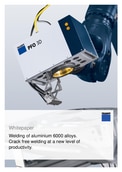
Laser welding aluminum alloys with a TruDisk laser and the BrightLine Weld option

Laser welding aluminum alloys with a TruDisk laser and the BrightLine Weld option

When welding materials such as aluminum 6000 alloy, users are faced with the challenge of hot cracks. These have a negative effect on weld seam quality and can lead to weld seam failure. Spattering may also occur, thereby contaminating surrounding parts. The white paper shows a welding application test in which the TruDisk 6001 processes 1 mm to 2 mm thick parts in weld seam positions that are susceptible to hot cracking. The application shows how the BrightLine Weld option improves welding results. Just fill out the form below to receive exciting background information and more details in our white paper. 

Manual: Laser marking in brief

Manual: Laser marking in brief

Discover the comprehensive  manual "Laser marking in brief" and find out about the technical background of the processes and laser systems as well as a guideline on practical marking.

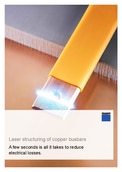
Laser structuring of copper busbars: Reduce your electrical losses in seconds

Laser structuring of copper busbars: Reduce your electrical losses in seconds

Efficiency is crucial in the world of electromobility. Small details like copper contacts can have a significant impact on the range and performance of electric vehicles. Conventional bolting methods lead to high contact resistance and energy loss. But TRUMPF has the solution: special lasers are used to precisely structure copper busbars, remove old oxide layers and create a new protective layer. The result? Significant reduction in losses and huge potential for increasing the efficiency of e-mobility worldwide.

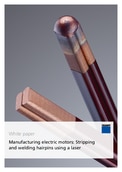
White paper: Laser welding of hairpins

White paper: Laser welding of hairpins

Hairpins are essential in manufacturing powerful electric motors for electromobility. You will discover in our white paper how lasers provide support during production and processing.  Simply fill out the form below and receive exclusive background information and more details in our white paper.  

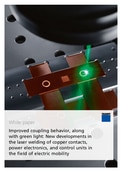
New developments in laser welding of copper contacts, power electronics, and control units in the field of electromobility

New developments in laser welding of copper contacts, power electronics, and control units in the field of electromobility

The application results are also improved due to the continuous further development of the beam sources. For example, industrial-grade lasers with a green wavelength and sufficient power enable copper contacts to be processed more productively and practically without any spatter in the field of electromobility. In our white paper you can read more about the latest developments and the numerous possible applications in electromobility.

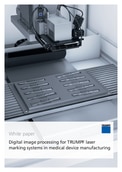
Image processing for TRUMPF marking systems in medical technology for UDI-compliant laser marking

Image processing for TRUMPF marking systems in medical technology for UDI-compliant laser marking

Lasers are used in medical technology to permanently mark products such as implants and tools. Markings of implants, surgical tools and medical utensils such as instrument cases must meet stringent requirements. TRUMPF provides turnkey complete solutions for UDI-compliant laser marking which satisfy the medical technology requirements for image processing.

Corrosion-free UDI laser marking with innovative spatter passivation

Corrosion-free UDI laser marking with innovative spatter passivation

Find out in this study why the combination of TruMark marking lasers with the new passivation method delivers excellent results in term of marking quality and corrosion resistance – and on a worst-case material at that: corrosion-prone steel 1.4112. 

Laser welding of prismatic cells with programmable focusing optics (PFO)

Laser welding of prismatic cells with programmable focusing optics (PFO)

Read our white paper to find out how PFO scanner optics can be used to seal batteries for e-mobility even faster and in a gas-tight manner.

Laser welding of prismatic cells with focusing optics (BEO)

Laser welding of prismatic cells with focusing optics (BEO)

In our white paper you can learn more about safely sealing batteries for electromobility using laser welding.

Display all results
Pages (646) Display all

Thomas Fehn, Chief Sales Officer at TRUMPF Laser Technology, explains in the video why TRUMPF is not only focused on improving its beam sources. - Gabriel Pankow LASER trade show: Thomas Fehn on TRUMPF innovations in laser technology TRUMPF presents its innovations at the leading trade show for laser technology LASER - World of Photonics. In this video, Thomas Fehn, Chief Sales Officer at TRUMPF Laser Technology, explains why this high-tech company is not only focusing on improving its beam sources. Laser AI Gabriel Pankow Spokesperson for Laser Technology Send feedback to the author Download item as PDF You might also be interested in: Sustainably improving supply chains with 3D printing Better safe than sorry: unmasking dangerous lasers Welding, cutting, melting: A machine made to measure

Welding battery packs for electromobility – TRUMPF lasers satisfy all requirements for tightness, crash safety and productivity. - Structural components of the battery pack The battery pack combines all components of a battery system and represents the heart of an electric car. TRUMPF provides a unique complete solution for electromobility for the tightness, crash safety, productivity and flexibility requirements. This means that you can weld all interior components as well as the battery housing with a high degree of precision – and always with process reliability thanks to an intelligent sensor system. The laser as a precision tool provides innovative solutions for the production and integration of the cooling system. Sheet metal components in the battery pack can be manufactured with networked system solutions of TRUMPF machine tools. For example, the battery tray is laser cut, reshaped and laser welded. Battery pack: compact and complex with many components Cover plate Cover plate for the protection of the battery cells and electronics The battery system must be protected against external influences to guarantee its function is long-lasting and high-performance. The component is brought into its final form with laser cutting, edge-forming, punching and bending processes. Surfaces are cleaned and structured and paints are removed to ensure safe sealing and electrical grounding. Battery tray The battery tray, enclosed protective housing for the battery unit, electronics and cooling unit TRUMPF machine systems process flat sheet metal by laser cutting, bending, punching dies and laser welding to create a gas-tight battery tray – depending on the requirements, this can also be done within a fully automated process. Seamless documentation, repeatability and traceability are a matter of course in the production process. Our experts will advise you from design to production and even beyond. Battery unit Scalable battery unit for a vehicle drive Lasers are the optimum tool for creating mechanically robust and highly conductive connections between live components (busbars). TRUMPF offers complete solution packages for battery pack production, from 2D laser cutting to bending and joining the module housing. High repeatability and low-spatter join connections ensure a cost-efficient production. Battery cell The battery cell, the heart of the battery system Lasers can be used in various industrial applications, ranging from drying the electrodes, precision cutting and welding of foil stacks to connect the cell conductors. TRUMPF has a unique laser portfolio for all battery cell applications, including lasers with green and infrared wavelengths, active beam formation as well as single and multi-mode lasers. Wiring and cables Electrical connection for signal and power transmission A laser is used for energy-efficient welding of live connections such as busbars and powerbars. Processing times and spatter formation are minimized with BrightLine Weld and TRUMPF welding depth monitoring. This ensures that every part is a good part. Marking lasers are used for clear and permanent component marking. Battery system cooling The battery system cooling provides optimum operating conditions An essential part of the battery pack is the cooling and heating system. Whether plate heat exchangers, pipes or punch press profiles, TRUMPF offers the suitable production system for every design and material. This creates the optimum surrounding conditions for a reliable and high-performance battery pack. Battery frame Battery frame: crash and supporting structure of the battery pack A stable supporting structure is essential for the best possible protection of the complex battery pack. Crash-optimized designs of flangeless connections can be implemented with the TRUMPF machine portfolio. This makes it possible to manufacture a particularly stable and simultaneously light supporting structure. Segmentation structure Segmentation structure for the battery module A stable frame is used to position the battery module in the battery tray. TRUMPF offers a wide spectrum of solutions for many joining tasks. An optimum system for quick and automated production is created with scanner optics in combination with OCT seam position detection, for example. Undertray protection Undertray protection of the battery pack To prevent or deflect possible damage to the battery system, a surface-covering and extremely resistant protection is required. TRUMPF components can be of excellent use in applications such as partial reinforcement by laser metal deposition or welding of high-tensile materials with scanner optics. Many challenges – one solution: these are the advantages of TRUMPF in battery pack production TRUMPF stands for industrial production solutions for the manufacture of all battery pack components. The combination of TRUMPF expertise in the advantages of laser technology with the flexibility of sheet metal processing provides customers with perfect solutions for the economic production of battery pack components. Thanks to energy-minimized, wear-free laser processing, it is possible to produce structural components with optimum stability. Not only that - the laser is also unbeatable in terms of weld seam quality, tightness and inspection effort. Furthermore, a comprehensive system of sensors constantly monitors the quality of the weld seams and ensures a precise welding depth. We cover the entire sheet metal process chain with our many years of comprehensive expertise in sheet metal processing. Our 2D laser cutting machines, bending machines and laser welding cells are used for the fully automated production of battery trays in networked processes, for example. An overview of the three most important laser applications Welding Would you like to produce high-tensile and helium-tight weld seams without thermally deforming the component? Thanks to innovative process management such as oscillation welding (wobbling) or new laser technologies like BrightLine Weld, TRUMPF is opening up the necessary design scope for the entire material variety of battery packs. TRUMPF provides the customized laser technology for every laser-supported welding process such as laser-hybrid welding, for example. Cleaning Whether paints, oils, greases or smoke residue, TRUMPF offers diverse cleaning solutions for contamination, which is absolutely mandatory to ensure technical cleanliness for adhesive bonding preparation. It is possible to prepare the most varied of geometries with our lasers and corresponding scanner optics. Marking TRUMPF lasers mark battery system components permanently and gently with high-contrast markings, for example with clear QR codes for part identification. TRUMPF VisionLine image processing makes it easy to check the marked code. E-mobility consulting - tackling e-mobility together Would you like to know how we can provide you with optimum support on your path to electromobility? Make an appointment directly with our internationally active branch managers. They are happy to advise you concerning our customized complete packages and facilitate new production technologies for the new mobility. Networked thinking and action: the TRUMPF advantage Whether it is cutting, bending or welding – TRUMPF offers everything from one source. You can process components selectively with the laser precision tool. This means in practice: the TRUMPF laser can be flexibly integrated into the process chain chronology. The components are only processed point by point, surrounding areas remain untouched, or are not damaged during cleaning, for example. Do you need support? Our industry experts and application engineers in the TRUMPF Laser Applications Center and Customer Center carry out feasibility tests, provide you with recommendations for concrete implementation and always find the correct parameters for your application. Compared to other laser manufacturers, we also support you in networking your laser systems - regardless of whether you are already taking big steps or are just starting out on the path to your company's networked future. Large-volume production solution Welding, bending, cutting, cleaning and marking – TRUMPF facilitates a comprehensive networked solution for all individual tasks, enabling seamless component traceability as well as a barrier-free development for the consolidated process chain. Reliable, highly productive systems Benefit from our decades of application experience for the different part processes and their technical implementation: our laser machines, inter-machine communication and innovative sensor technologies facilitate the continuity of the process chain and constant quality monitoring. Highest productivity at all times and all relevant information at a glance The Condition Based Services increase the technical availability of your laser systems. Use dashboards to visualize the state of the machine - Smart View Services. The TRUMPF Condition Monitoring Center evaluates sensor data and detects failure risks. You receive relevant data concerning your laser using the Data Based Services. The OPC-UA interface provides important information for this purpose. The Quality Data Storage 2 software also makes it possible to record data synchronously to the process. Customized process advice and support from TRUMPF branch management Does every new beginning have to be difficult? Not with TRUMPF. For we know how you can reduce your high start-up expenditures: our designated TRUMPF industry experts are at your side with a thorough and customized process and application consulting service. "Combining laser technology with the flexible production solutions from TRUMPF enabled us to develop an innovative concept for the economic manufacturing of battery systems – and TRUMPF's unique branch management provided the necessary expertise for the introduction and customized implementation." Ludger Gehringhoff Customer Program Manager Benteler Automotive Many cases, one worthwhile visit: our TRUMPF Laser Applications Center and Customer Center Would you like to see the benefits of lasers in battery pack production for yourself? Visit us in one of our showrooms on-site and make the most of the consulting services of our experts: Production of prototypes made of sheet metal Individual customer parts are manufactured in TRUMPF precision machines and are checked to ensure they meet the material requirements. We identify the optimization potential in the production of your part along with you. The goal: we will optimize and manufacture selected parts which you can directly implement into your designs and manufacture more cost-effectively. Advice for the design of sheet metal parts What potential is still hidden in your parts? Discover it for yourself: in our workshops and seminars on part optimization in sheet metal and tubes. You will trim your parts for success with our consolidated expertise in sheet metal design - and save money as well. For economically constructed parts are the key to efficient manufacturing, require fewer process steps and pave your way toward networked production. Customized automated production systems No two productions are the same. This is why your path to the Smart Factory is also unique. Consultancy for networked production is precisely where we come in. No matter whether you are already making great strides into the networked future of your company or you are just starting out – with a strong, competent partner by your side, it will be easier to walk into your automated future. No two paths are the same because TruConnect combines individual components to provide customized solutions for you. White paper PDF - 592 KB Laser welding of battery packs The growing demand for electric vehicles is increasing the need for efficient battery pack manufacturing. Laser welding ensures strong and tight seams for longer durability. TRUMPF's automated laser welding systems, such as TruLaser Weld and TruLaser Cell 5000, are fast and cost-effective. Find out more in the white paper. Nothing is quite like a personal conversation: visit TRUMPF in Ditzingen We ensure TRUMPF products are an all-embracing experience for our customers. Whether it is in the TRUMPF Laser Applications Center or Customer Center – & our experts in Ditzingen will show you what is possible – in person and in line with your requirements. Our application specialists and industry experts will support you during application development and optimization of your specific component in the Laser Applications Center, a center extending over an area of 4000 m². On the other hand, you will experience the entire sheet metal process chain – from programming to laser welding – in our Customer Center. We offer individual guided tours as well as live demonstrations of the technologies. Time studies, feasibilities and generation of sample parts are also part of the core tasks. Contact Industry management Phone +49 7156 30330862 Email

In the video, Hagen Zimer, CEO of TRUMPF Laser Technology, explains how TRUMPF helps its customers implement their laser applications as solution provider. - Date created 06/30/2025 Laser Fiber laser AI Gabriel Pankow Spokesperson for Laser Technology Send feedback to the author Download item as PDF

Busbar Laser Welding for Power Electronics In EV power electronics production, precision and consistency are essential for ensuring safety and performance. TRUMPF’s full-process control laser welding solution delivers accuracy, quality, and traceability at every welding step. By integrating BrightLine Weld technology, power and focus calibration, cover glass monitoring, an AI-powered intelligent vision system, and an OCT sensor for pre-, in-, and post-weld monitoring and inspection, this solution enables precise, scalable, high-throughput manufacturing—supporting the shift to intelligent, data-driven EV power electronics production. Watch How TRUMPF Transforms Battery Manufacturing Laser Welding for Power Modules Key Features BrightLine Weld TRUMPF’s patented BrightLine Weld technology improves busbar welding by reducing weld spatter by up to 90%, minimizing heat input, and enhancing electrical conductivity and structural integrity. It ensures cleaner, faster, and more stable welds, boosting efficiency and quality in battery pack production. CalibrationLine Contaminated protective glass can cause laser power loss during busbar welding, leading to reduced penetration depth. With TRUMPF’s CalibrationLine function, both laser power and focus are automatically monitored and calibrated, ensuring consistent weld quality and reliable process performance. Inline process monitoring The VisionLine OCT Check process sensor system enables reliable and precise monitoring of weld depth using optical coherence tomography (OCT). This allows for real-time, process-synchronous quality assurance, such as measuring keyhole depth during deep welding. Thanks to the seamless integration of the PFO and OCT, consistent keyhole depth measurement is possible across the entire PFO work area—without the need for parameter adjustments. Quality data storage The system records process data and stores it in flexible storage locations. This data stays with you locally. This means that your data quality assurance is automated. For seamless traceability, you can assign the applicable relevant process data from the laser, the optics or other process sensors to each component. This enables you to analyze data over several processes as well, and it subsequently makes it easier to determine the cause of quality defect. Cast Aluminum housing welding with multi-focus Power electronics are typically housed in environmentally sealed cast aluminum enclosures. Traditional sealing methods—such as gaskets and screws—add time, cost, and offer limited durability. TRUMPF’s multi-focus optic technology enables laser welding for hermetic sealing of cast aluminum housings, delivering faster, more cost-effective production and long-lasting protection against environmental influences. Pre and post weld inspection using AI powered Vision system A smart camera is integrated into TRUMPF’s welding optics through the AI-powered VisionLine system. It significantly improves position detection of even the smallest components before welding and evaluates weld quality based on the surface condition of the weld bead. Combined with in-process monitoring, it provides a comprehensive quality check—directly within the welding station. Trusted by Industry Leaders For good results in characteristics recognition, we now need hours rather than days. Dr. Ing. Daniel Weller Joining technology specialist in the Battery Technology business division at ElringKlinger AG When it comes to copper welding, we rely exclusively on the green laser. Jörn Schmalenberg Manufacturing Engineering, Webasto in Neubrandenburg Meet The Expert Pierson Cheng – Battery Industry Manager Pierson Cheng serves as the in-house technical specialist for laser processing in battery cell-to-pack manufacturing. With over 20 years of experience across various roles at TRUMPF in both the U.S. and China, he brings deep expertise in laser applications for the battery industry. Pierson collaborates closely with leading battery gigafactories and emerging start-ups across North America, supporting the adoption of advanced laser technologies to drive innovation, precision, and efficiency in battery manufacturing. Reach out to Pierson Cheng by email: pierson.cheng@trumpf.com

Request a quote Laser markings are long-lasting and high-contrast. Distinguished by sharp edges, laser marking is the ideal application for the medical industry. Easily legible as well as chemically and thermally resistant, TRUMPF provides you with a tailor-made medical technology package including application consultation. High quality marking solutions High production, low stress TRUMPF's highly productive laser marking systems are the turn-key solutions for all your marking needs. See your mark clearly with VisionLine VisionLine image processing detects the positioning of the component and ensures that marking is performed in the correct location. UDI marking made easy Better in a bundle: TRUMPF has the laser plus the right software for the Unique Device Identification of your medical products. Laser markings that last Whether UDI or Data Matrix Code- laser markings are abrasion, temperature and chemical resistant and thus meet all FDA requirements. Black marking vs. laser annealing Laser annealing is used to improve the properties of a material , while black marking is used to create a visible mark on a surface . In this video, our laser applications engineer, Clinton Coleman, shows the key differences in the TRUMPF Laser Application Center. Request a quote for your marking solution If you are interested in our laser marking products, please contact us and we will send you a non-binding offer. What application works best for you? Corrosion Free Solution When it comes to high-quality black marking, TruMark Station 7000 with TruMicroMark 2030 is the right choice. Permanent legible labeling of medical devices with a traceable UDI code. Corrosion resistant markings remain legible after numerous cleaning cycles. Due to using an ultrashort pulse laser, this process is ideal for marking small text and barcodes on medical devices. Flexible Standard System For annealing medical products, the TruMark Station 5000 with TruMark 6030 is the perfect tool. Long lasting and resistant to abrasion, so you don't have to worry about markings wearing away over time. Particularly suitable for objects which are often cleaned as organic residue does not stick to the surface. With its low heat input, the laser does not change the texture of the material surface . Request a quote Please fill out the contact information below to request a quote for TRUMPF laser marking products. Your data First name * Last name * Email * Company * Street and no. * ZIP * City * Phone * Product options * Corrosion Free Solution: TruMark Station 7000 + TruMicro Mark 2030 -> Blackmarking Flexible Standard System: TruMark Station 5000 + TruMark 6030 -> Annealing Your message Further information on data protection at TRUMPF can be found in our privacy statement . Contact Sales Laser Technology Phone +1 734-454-7200 Email

Display all results
204 results
321 results
Laser welding aluminum alloys with a TruDisk laser and the BrightLine Weld option

Laser welding aluminum alloys with a TruDisk laser and the BrightLine Weld option

When welding materials such as aluminum 6000 alloy, users are faced with the challenge of hot cracks. These have a negative effect on weld seam quality and can lead to weld seam failure. Spattering may also occur, thereby contaminating surrounding parts. The white paper shows a welding application test in which the TruDisk 6001 processes 1 mm to 2 mm thick parts in weld seam positions that are susceptible to hot cracking. The application shows how the BrightLine Weld option improves welding results. Just fill out the form below to receive exciting background information and more details in our white paper. 

Manual: Laser marking in brief

Manual: Laser marking in brief

Discover the comprehensive  manual "Laser marking in brief" and find out about the technical background of the processes and laser systems as well as a guideline on practical marking.

Laser structuring of copper busbars: Reduce your electrical losses in seconds

Laser structuring of copper busbars: Reduce your electrical losses in seconds

Efficiency is crucial in the world of electromobility. Small details like copper contacts can have a significant impact on the range and performance of electric vehicles. Conventional bolting methods lead to high contact resistance and energy loss. But TRUMPF has the solution: special lasers are used to precisely structure copper busbars, remove old oxide layers and create a new protective layer. The result? Significant reduction in losses and huge potential for increasing the efficiency of e-mobility worldwide.

White paper: Laser welding of hairpins

White paper: Laser welding of hairpins

Hairpins are essential in manufacturing powerful electric motors for electromobility. You will discover in our white paper how lasers provide support during production and processing.  Simply fill out the form below and receive exclusive background information and more details in our white paper.  

New developments in laser welding of copper contacts, power electronics, and control units in the field of electromobility

New developments in laser welding of copper contacts, power electronics, and control units in the field of electromobility

The application results are also improved due to the continuous further development of the beam sources. For example, industrial-grade lasers with a green wavelength and sufficient power enable copper contacts to be processed more productively and practically without any spatter in the field of electromobility. In our white paper you can read more about the latest developments and the numerous possible applications in electromobility.

Image processing for TRUMPF marking systems in medical technology for UDI-compliant laser marking

Image processing for TRUMPF marking systems in medical technology for UDI-compliant laser marking

Lasers are used in medical technology to permanently mark products such as implants and tools. Markings of implants, surgical tools and medical utensils such as instrument cases must meet stringent requirements. TRUMPF provides turnkey complete solutions for UDI-compliant laser marking which satisfy the medical technology requirements for image processing.

Corrosion-free UDI laser marking with innovative spatter passivation

Corrosion-free UDI laser marking with innovative spatter passivation

Find out in this study why the combination of TruMark marking lasers with the new passivation method delivers excellent results in term of marking quality and corrosion resistance – and on a worst-case material at that: corrosion-prone steel 1.4112. 

Laser welding of prismatic cells with programmable focusing optics (PFO)

Laser welding of prismatic cells with programmable focusing optics (PFO)

Read our white paper to find out how PFO scanner optics can be used to seal batteries for e-mobility even faster and in a gas-tight manner.

Laser welding of prismatic cells with focusing optics (BEO)

Laser welding of prismatic cells with focusing optics (BEO)

In our white paper you can learn more about safely sealing batteries for electromobility using laser welding.

Laser welding cast aluminum

Laser welding cast aluminum

Multifocus optics, developed by TRUMPF specifically for this application, combined with BrightLine Weld, make possible that which was previously impossible: welding aluminum cast containers with lasers so that they are gas-tight – a quick and process-reliable procedure, even in large batch numbers.

Load more An error occurred while loading the data
646 results

Thomas Fehn, Chief Sales Officer at TRUMPF Laser Technology, explains in the video why TRUMPF is not only focused on improving its beam sources. - Gabriel Pankow LASER trade show: Thomas Fehn on TRUMPF innovations in laser technology TRUMPF presents its innovations at the leading trade show for laser technology LASER - World of Photonics. In this video, Thomas Fehn, Chief Sales Officer at TRUMPF Laser Technology, explains why this high-tech company is not only focusing on improving its beam sources. Laser AI Gabriel Pankow Spokesperson for Laser Technology Send feedback to the author Download item as PDF You might also be interested in: Sustainably improving supply chains with 3D printing Better safe than sorry: unmasking dangerous lasers Welding, cutting, melting: A machine made to measure

Welding battery packs for electromobility – TRUMPF lasers satisfy all requirements for tightness, crash safety and productivity. - Structural components of the battery pack The battery pack combines all components of a battery system and represents the heart of an electric car. TRUMPF provides a unique complete solution for electromobility for the tightness, crash safety, productivity and flexibility requirements. This means that you can weld all interior components as well as the battery housing with a high degree of precision – and always with process reliability thanks to an intelligent sensor system. The laser as a precision tool provides innovative solutions for the production and integration of the cooling system. Sheet metal components in the battery pack can be manufactured with networked system solutions of TRUMPF machine tools. For example, the battery tray is laser cut, reshaped and laser welded. Battery pack: compact and complex with many components Cover plate Cover plate for the protection of the battery cells and electronics The battery system must be protected against external influences to guarantee its function is long-lasting and high-performance. The component is brought into its final form with laser cutting, edge-forming, punching and bending processes. Surfaces are cleaned and structured and paints are removed to ensure safe sealing and electrical grounding. Battery tray The battery tray, enclosed protective housing for the battery unit, electronics and cooling unit TRUMPF machine systems process flat sheet metal by laser cutting, bending, punching dies and laser welding to create a gas-tight battery tray – depending on the requirements, this can also be done within a fully automated process. Seamless documentation, repeatability and traceability are a matter of course in the production process. Our experts will advise you from design to production and even beyond. Battery unit Scalable battery unit for a vehicle drive Lasers are the optimum tool for creating mechanically robust and highly conductive connections between live components (busbars). TRUMPF offers complete solution packages for battery pack production, from 2D laser cutting to bending and joining the module housing. High repeatability and low-spatter join connections ensure a cost-efficient production. Battery cell The battery cell, the heart of the battery system Lasers can be used in various industrial applications, ranging from drying the electrodes, precision cutting and welding of foil stacks to connect the cell conductors. TRUMPF has a unique laser portfolio for all battery cell applications, including lasers with green and infrared wavelengths, active beam formation as well as single and multi-mode lasers. Wiring and cables Electrical connection for signal and power transmission A laser is used for energy-efficient welding of live connections such as busbars and powerbars. Processing times and spatter formation are minimized with BrightLine Weld and TRUMPF welding depth monitoring. This ensures that every part is a good part. Marking lasers are used for clear and permanent component marking. Battery system cooling The battery system cooling provides optimum operating conditions An essential part of the battery pack is the cooling and heating system. Whether plate heat exchangers, pipes or punch press profiles, TRUMPF offers the suitable production system for every design and material. This creates the optimum surrounding conditions for a reliable and high-performance battery pack. Battery frame Battery frame: crash and supporting structure of the battery pack A stable supporting structure is essential for the best possible protection of the complex battery pack. Crash-optimized designs of flangeless connections can be implemented with the TRUMPF machine portfolio. This makes it possible to manufacture a particularly stable and simultaneously light supporting structure. Segmentation structure Segmentation structure for the battery module A stable frame is used to position the battery module in the battery tray. TRUMPF offers a wide spectrum of solutions for many joining tasks. An optimum system for quick and automated production is created with scanner optics in combination with OCT seam position detection, for example. Undertray protection Undertray protection of the battery pack To prevent or deflect possible damage to the battery system, a surface-covering and extremely resistant protection is required. TRUMPF components can be of excellent use in applications such as partial reinforcement by laser metal deposition or welding of high-tensile materials with scanner optics. Many challenges – one solution: these are the advantages of TRUMPF in battery pack production TRUMPF stands for industrial production solutions for the manufacture of all battery pack components. The combination of TRUMPF expertise in the advantages of laser technology with the flexibility of sheet metal processing provides customers with perfect solutions for the economic production of battery pack components. Thanks to energy-minimized, wear-free laser processing, it is possible to produce structural components with optimum stability. Not only that - the laser is also unbeatable in terms of weld seam quality, tightness and inspection effort. Furthermore, a comprehensive system of sensors constantly monitors the quality of the weld seams and ensures a precise welding depth. We cover the entire sheet metal process chain with our many years of comprehensive expertise in sheet metal processing. Our 2D laser cutting machines, bending machines and laser welding cells are used for the fully automated production of battery trays in networked processes, for example. An overview of the three most important laser applications Welding Would you like to produce high-tensile and helium-tight weld seams without thermally deforming the component? Thanks to innovative process management such as oscillation welding (wobbling) or new laser technologies like BrightLine Weld, TRUMPF is opening up the necessary design scope for the entire material variety of battery packs. TRUMPF provides the customized laser technology for every laser-supported welding process such as laser-hybrid welding, for example. Cleaning Whether paints, oils, greases or smoke residue, TRUMPF offers diverse cleaning solutions for contamination, which is absolutely mandatory to ensure technical cleanliness for adhesive bonding preparation. It is possible to prepare the most varied of geometries with our lasers and corresponding scanner optics. Marking TRUMPF lasers mark battery system components permanently and gently with high-contrast markings, for example with clear QR codes for part identification. TRUMPF VisionLine image processing makes it easy to check the marked code. E-mobility consulting - tackling e-mobility together Would you like to know how we can provide you with optimum support on your path to electromobility? Make an appointment directly with our internationally active branch managers. They are happy to advise you concerning our customized complete packages and facilitate new production technologies for the new mobility. Networked thinking and action: the TRUMPF advantage Whether it is cutting, bending or welding – TRUMPF offers everything from one source. You can process components selectively with the laser precision tool. This means in practice: the TRUMPF laser can be flexibly integrated into the process chain chronology. The components are only processed point by point, surrounding areas remain untouched, or are not damaged during cleaning, for example. Do you need support? Our industry experts and application engineers in the TRUMPF Laser Applications Center and Customer Center carry out feasibility tests, provide you with recommendations for concrete implementation and always find the correct parameters for your application. Compared to other laser manufacturers, we also support you in networking your laser systems - regardless of whether you are already taking big steps or are just starting out on the path to your company's networked future. Large-volume production solution Welding, bending, cutting, cleaning and marking – TRUMPF facilitates a comprehensive networked solution for all individual tasks, enabling seamless component traceability as well as a barrier-free development for the consolidated process chain. Reliable, highly productive systems Benefit from our decades of application experience for the different part processes and their technical implementation: our laser machines, inter-machine communication and innovative sensor technologies facilitate the continuity of the process chain and constant quality monitoring. Highest productivity at all times and all relevant information at a glance The Condition Based Services increase the technical availability of your laser systems. Use dashboards to visualize the state of the machine - Smart View Services. The TRUMPF Condition Monitoring Center evaluates sensor data and detects failure risks. You receive relevant data concerning your laser using the Data Based Services. The OPC-UA interface provides important information for this purpose. The Quality Data Storage 2 software also makes it possible to record data synchronously to the process. Customized process advice and support from TRUMPF branch management Does every new beginning have to be difficult? Not with TRUMPF. For we know how you can reduce your high start-up expenditures: our designated TRUMPF industry experts are at your side with a thorough and customized process and application consulting service. "Combining laser technology with the flexible production solutions from TRUMPF enabled us to develop an innovative concept for the economic manufacturing of battery systems – and TRUMPF's unique branch management provided the necessary expertise for the introduction and customized implementation." Ludger Gehringhoff Customer Program Manager Benteler Automotive Many cases, one worthwhile visit: our TRUMPF Laser Applications Center and Customer Center Would you like to see the benefits of lasers in battery pack production for yourself? Visit us in one of our showrooms on-site and make the most of the consulting services of our experts: Production of prototypes made of sheet metal Individual customer parts are manufactured in TRUMPF precision machines and are checked to ensure they meet the material requirements. We identify the optimization potential in the production of your part along with you. The goal: we will optimize and manufacture selected parts which you can directly implement into your designs and manufacture more cost-effectively. Advice for the design of sheet metal parts What potential is still hidden in your parts? Discover it for yourself: in our workshops and seminars on part optimization in sheet metal and tubes. You will trim your parts for success with our consolidated expertise in sheet metal design - and save money as well. For economically constructed parts are the key to efficient manufacturing, require fewer process steps and pave your way toward networked production. Customized automated production systems No two productions are the same. This is why your path to the Smart Factory is also unique. Consultancy for networked production is precisely where we come in. No matter whether you are already making great strides into the networked future of your company or you are just starting out – with a strong, competent partner by your side, it will be easier to walk into your automated future. No two paths are the same because TruConnect combines individual components to provide customized solutions for you. White paper PDF - 592 KB Laser welding of battery packs The growing demand for electric vehicles is increasing the need for efficient battery pack manufacturing. Laser welding ensures strong and tight seams for longer durability. TRUMPF's automated laser welding systems, such as TruLaser Weld and TruLaser Cell 5000, are fast and cost-effective. Find out more in the white paper. Nothing is quite like a personal conversation: visit TRUMPF in Ditzingen We ensure TRUMPF products are an all-embracing experience for our customers. Whether it is in the TRUMPF Laser Applications Center or Customer Center – & our experts in Ditzingen will show you what is possible – in person and in line with your requirements. Our application specialists and industry experts will support you during application development and optimization of your specific component in the Laser Applications Center, a center extending over an area of 4000 m². On the other hand, you will experience the entire sheet metal process chain – from programming to laser welding – in our Customer Center. We offer individual guided tours as well as live demonstrations of the technologies. Time studies, feasibilities and generation of sample parts are also part of the core tasks. Contact Industry management Phone +49 7156 30330862 Email

In the video, Hagen Zimer, CEO of TRUMPF Laser Technology, explains how TRUMPF helps its customers implement their laser applications as solution provider. - Date created 06/30/2025 Laser Fiber laser AI Gabriel Pankow Spokesperson for Laser Technology Send feedback to the author Download item as PDF

Busbar Laser Welding for Power Electronics In EV power electronics production, precision and consistency are essential for ensuring safety and performance. TRUMPF’s full-process control laser welding solution delivers accuracy, quality, and traceability at every welding step. By integrating BrightLine Weld technology, power and focus calibration, cover glass monitoring, an AI-powered intelligent vision system, and an OCT sensor for pre-, in-, and post-weld monitoring and inspection, this solution enables precise, scalable, high-throughput manufacturing—supporting the shift to intelligent, data-driven EV power electronics production. Watch How TRUMPF Transforms Battery Manufacturing Laser Welding for Power Modules Key Features BrightLine Weld TRUMPF’s patented BrightLine Weld technology improves busbar welding by reducing weld spatter by up to 90%, minimizing heat input, and enhancing electrical conductivity and structural integrity. It ensures cleaner, faster, and more stable welds, boosting efficiency and quality in battery pack production. CalibrationLine Contaminated protective glass can cause laser power loss during busbar welding, leading to reduced penetration depth. With TRUMPF’s CalibrationLine function, both laser power and focus are automatically monitored and calibrated, ensuring consistent weld quality and reliable process performance. Inline process monitoring The VisionLine OCT Check process sensor system enables reliable and precise monitoring of weld depth using optical coherence tomography (OCT). This allows for real-time, process-synchronous quality assurance, such as measuring keyhole depth during deep welding. Thanks to the seamless integration of the PFO and OCT, consistent keyhole depth measurement is possible across the entire PFO work area—without the need for parameter adjustments. Quality data storage The system records process data and stores it in flexible storage locations. This data stays with you locally. This means that your data quality assurance is automated. For seamless traceability, you can assign the applicable relevant process data from the laser, the optics or other process sensors to each component. This enables you to analyze data over several processes as well, and it subsequently makes it easier to determine the cause of quality defect. Cast Aluminum housing welding with multi-focus Power electronics are typically housed in environmentally sealed cast aluminum enclosures. Traditional sealing methods—such as gaskets and screws—add time, cost, and offer limited durability. TRUMPF’s multi-focus optic technology enables laser welding for hermetic sealing of cast aluminum housings, delivering faster, more cost-effective production and long-lasting protection against environmental influences. Pre and post weld inspection using AI powered Vision system A smart camera is integrated into TRUMPF’s welding optics through the AI-powered VisionLine system. It significantly improves position detection of even the smallest components before welding and evaluates weld quality based on the surface condition of the weld bead. Combined with in-process monitoring, it provides a comprehensive quality check—directly within the welding station. Trusted by Industry Leaders For good results in characteristics recognition, we now need hours rather than days. Dr. Ing. Daniel Weller Joining technology specialist in the Battery Technology business division at ElringKlinger AG When it comes to copper welding, we rely exclusively on the green laser. Jörn Schmalenberg Manufacturing Engineering, Webasto in Neubrandenburg Meet The Expert Pierson Cheng – Battery Industry Manager Pierson Cheng serves as the in-house technical specialist for laser processing in battery cell-to-pack manufacturing. With over 20 years of experience across various roles at TRUMPF in both the U.S. and China, he brings deep expertise in laser applications for the battery industry. Pierson collaborates closely with leading battery gigafactories and emerging start-ups across North America, supporting the adoption of advanced laser technologies to drive innovation, precision, and efficiency in battery manufacturing. Reach out to Pierson Cheng by email: pierson.cheng@trumpf.com

Request a quote Laser markings are long-lasting and high-contrast. Distinguished by sharp edges, laser marking is the ideal application for the medical industry. Easily legible as well as chemically and thermally resistant, TRUMPF provides you with a tailor-made medical technology package including application consultation. High quality marking solutions High production, low stress TRUMPF's highly productive laser marking systems are the turn-key solutions for all your marking needs. See your mark clearly with VisionLine VisionLine image processing detects the positioning of the component and ensures that marking is performed in the correct location. UDI marking made easy Better in a bundle: TRUMPF has the laser plus the right software for the Unique Device Identification of your medical products. Laser markings that last Whether UDI or Data Matrix Code- laser markings are abrasion, temperature and chemical resistant and thus meet all FDA requirements. Black marking vs. laser annealing Laser annealing is used to improve the properties of a material , while black marking is used to create a visible mark on a surface . In this video, our laser applications engineer, Clinton Coleman, shows the key differences in the TRUMPF Laser Application Center. Request a quote for your marking solution If you are interested in our laser marking products, please contact us and we will send you a non-binding offer. What application works best for you? Corrosion Free Solution When it comes to high-quality black marking, TruMark Station 7000 with TruMicroMark 2030 is the right choice. Permanent legible labeling of medical devices with a traceable UDI code. Corrosion resistant markings remain legible after numerous cleaning cycles. Due to using an ultrashort pulse laser, this process is ideal for marking small text and barcodes on medical devices. Flexible Standard System For annealing medical products, the TruMark Station 5000 with TruMark 6030 is the perfect tool. Long lasting and resistant to abrasion, so you don't have to worry about markings wearing away over time. Particularly suitable for objects which are often cleaned as organic residue does not stick to the surface. With its low heat input, the laser does not change the texture of the material surface . Request a quote Please fill out the contact information below to request a quote for TRUMPF laser marking products. Your data First name * Last name * Email * Company * Street and no. * ZIP * City * Phone * Product options * Corrosion Free Solution: TruMark Station 7000 + TruMicro Mark 2030 -> Blackmarking Flexible Standard System: TruMark Station 5000 + TruMark 6030 -> Annealing Your message Further information on data protection at TRUMPF can be found in our privacy statement . Contact Sales Laser Technology Phone +1 734-454-7200 Email

The TruLaser Tube 3000 fiber is the machine for you - no matter what industry you work in. It is ideal for first-time users or as a supplementary machine thanks to its easy handling. Cutting tube profiles for a variety of industries Furniture Cut tubes and profiles with great precision, enabling the production of products of the highest quality. Fitness equipment Produce high-quality components efficiently and with high precision. Agricultural machinery Process tubes with thick walls, ideal for components for agricultural machinery. Contact us today Your data First name * Last name * Company * City * Federal state * Phone * Email * Your message * Further information on data protection at TRUMPF can be found in our privacy statement . Discover TruLaser Tube Technology Click here to view our entire portfolio of tube laser cutting machines.

People learn to hear again with cochlear implants from MED-EL. The delicate components are labeled with TRUMPF marking lasers. - © Daniel Zangerl / MED-EL Daniel Kurr High-tech deaf aid: Implant maker uses TRUMPF marking laser P eople who are born deaf live in absolute silence - separated from noises and sounds. The inability to hear means that conversation with hearing persons, language acquisition, and enjoyment of music is significantly more difficult. MED-EL is changing that. With its cochlear implants and audio processors, people learn to hear again - or hear for the first time in their lives. The Tyrolean company uses TRUMPF marking lasers to add high-contrast markings to the delicate metal and plastic components. Paula snuggles up to her mum and listens spellbound to her bedtime story. She loves books, especially when someone reads to her. The five-year-old's ability to hear words and even music was something that seemed impossible shortly after her birth. Paula was born profoundly deaf. She couldn't hear the voices of her parents and siblings or the sounds of her environment. One in 1,000 children in Germany is born without hearing, like Paula. Their families are then faced with a decision. Do they choose hearing implants or sign language? Paula's parents were committed to providing their daughter with the most inclusive life possible, so they opted for a cochlear implant. A cochlear implant is a hearing aid that is implanted in the cochlea. Complex system These hearing systems consist of an audio processor with a microphone, and the implant itself. Patients wear the processor behind their ear. It detects sounds in the environment and adjusts the tones and volume, reduces distracting background noise and amplifies subtle sounds. Surgeons insert the implant under the skin. The cochlear implant assumes the role of sensory hair cells in the ear by electrically stimulating the auditory nerve, thereby restoring the ability to hear. MED-EL cochlear implants help some people to hear for the first time in their lives. For MED-EL production experts Dietmar Köll (right) and Christoph Fankhauser, this is the greatest source of motivation for their daily work. The hearing system consists of an audio processor that is worn behind the ear and an implant that surgeons place under the skin. MED-EL marks the plastic and metal components using three TruMark Station 5000 with TruMark Series 3000 lasers. Removing barriers to hearing The Austrian company MED-EL, based in Innsbruck, specializes in the development and manufacture of cochlear implants. Its product portfolio includes implantable and non-implantable hearing systems. The family business has 2,500 employees. In addition to clinics and medical professionals, audiologists are also among the customers who provide ongoing support to patients post-surgery. Dietmar Köll, production manager at MED-EL, explains: "Not being able to see separates you from things - not being able to hear separates you from people." Köll and his team are working to change that. "With our products, we want to overcome hearing loss as a barrier to communication and quality of life and help people regain their zest for life. It is a lovely job." No two ears are the same MED-EL focuses on a wide range of products, because people's ears - or cochleas - are as unique as the individuals themselves. Dietmar Köll explains: "We adopt an extremely dynamic approach to our work and try to incorporate customer feedback into our products. That is why we offer a very broad portfolio with a modular structure. We have a range of processors and implants. We assemble these products based on the individual requirements of the patients. This allows us to find the optimal solution for different hearing situations." Precise markings in tight spaces Producing small batches with customized markings is a routine task at the Innsbruck production facility. This is where MED-EL assembles the cochlear implants and audio processors and applies markings to the small metal and plastic components. The Tyrolean hearing experts are currently focusing on two particular trends: To make the devices more comfortable to wear, the components are becoming ever smaller, while at the same time the requirements for traceability and documentation of products and manufacturing processes are increasing. The production team therefore has to apply more and more markings in ever-tighter spaces. The markings also have to be legible and durable. This requires dependable production technologies with stringent standards. Standardized processes are the key to success for MED-EL. A high contrast is crucial for this because it ensures good readability. TruMark lasers cope with this job with aplomb. To make the devices more comfortable to wear, the components are becoming ever smaller. Nevertheless, the markings and codes must be resistant and machine-readable. High-contrast and resistant MED-EL uses three TruMark Station 5000 machines from TRUMPF to do the job. Equipped with lasers from the TruMark Series 3000 , they mark components made of titanium, platinum-iridium and plastic. Deputy production manager Christoph Fankhauser explains: "We mainly apply serial numbers and unique device ID codes, or UDI for short, to metal and plastic parts. This machine-readable, universal product code is mandatory for medical devices in Europe. We also label the parts with symbols such as arrows and instructions to make handling easier for users." Uniform gradients are of utmost importance for MED-EL, as many of the labels are prominently displayed on the final product. A high contrast is crucial for this because it ensures good readability. "And, of course, the markings must be reproducible. In other words, the result must always be the same, even if there are possible fluctuations in material quality," emphasizes Fankhauser. "This requires a high level of power stability. The TruMark laser meets these requirements - even on the tiniest components." A full sensory experience Paula is unaware of all the dedication and hard work put in by the cochlear experts. For Paula, the joy of running around the house loudly with her siblings and attending kindergarten every day is simply part and parcel of her daily routine. Her cochlear implant has brought sound to life for her, and she now relishes it with all her senses. Cochlear implants - a brief explanation A cochlear implant consists of two parts: An audio processor with a microphone, which is worn behind the ear and detects sounds and noises, and the implant itself, which is inserted under the skin. An electrode array runs from the implant into the inner ear. This long, flexible platinum wire is fitted with electrodes and coated with silicone. When the audio processor receives sounds, they are transmitted to the implant as electrical signals. It converts these into electrical impulses, which the electrode array conducts into the cochlea to stimulate the auditory nerve. This transmits the auditory sensations to the brain, which interprets them as sounds and noises. Even those who are profoundly hearing impaired or born deaf can learn to hear with the device. The artificial impulse generated by the implant sounds different from natural sounds. Much like a new language, the brain must first learn to understand it. Regular language training helps with this. © MED-EL Laser Laser marking Science Daniel Kurr TRUMPF Group Communications Send feedback to the author Download item as PDF You may also be interested in: Stars, steel and silhouettes – laser meets Japanese art A half-century at the company: "TRUMPF is my second home" Fit machines are making exercise equipment for muscles of steel

TRUMPF lasers perform a wide variety of cutting and drilling work in metal, plastic, paper, and stone using a non-contact processing method. - Laser cutting as a contact-free slitting process Laser cutting is a slitting process with which it is possible to cut metallic and non-metallic raw materials of different material thicknesses. This is based around a laser beam which is guided, formed, and bundled. When it hits the workpiece, the material heats up to the extent that it melts or vaporizes. In this process, the whole laser power is concentrated on one point, with a diameter that is often less than half a millimeter. If more heat is introduced into this area than can dissipate through heat conduction, the laser beam will penetrate the material entirely – the cutting process has begun. While other processes involve applying large-scale tools with enormous power to the sheet metal, the laser beam completes its task without any contact. In this way, the tool does not incur wear, and no deformities or damage to the workpiece occur. Advantages of laser cutting Material range All materials common in industrial processing – from steel to aluminum, stainless steel, and non-ferrous metal sheets, all the way to non-metal materials such as plastics, glass, wood, or ceramics – can be cut safely and in high quality with the laser. Very different sheet thicknesses of 0.5 to over 30 millimeters can be cut using the tool. This extremely wide material range makes the laser the top cutting tool for many applications in the area of metals and non-metals. Contour freedom The bundled laser beam only heats up the material locally, and the rest of the workpiece is subjected to minimal thermal stresses or not at all. This means the kerf is barely wider than the beam and even complex, intricate contours may be cut smoothly and free of burrs. Time-consuming post-processing is no longer necessary in most cases. Due to its flexibility, this cutting procedure is often used for small lot sizes, large variant ranges, and in prototype construction. High-quality cutting edges with ultrashort pulses Ultrashort pulse lasers vaporize virtually every material so quickly that heat influence cannot be detected, thereby creating high-quality cutting edges without ejection of melted material. This makes the lasers ideal for the manufacture of the most intricate metal products, such as stents for medical technology. In the display industry, ultrashort pulse lasers cut chemically hardened glass. Discover our products for laser cutting Whether 2D or 3D laser processing – TRUMPF offers machines and systems for extremely various applications for you. The laser cutting process The interaction between a focused laser beam and workpiece forms the basis of laser cutting. In order for this process to be carried out reliably and precisely, numerous components and additional equipment are used on and around the laser beam, which will be illustrated in the following graphic. Focusing optics: lens and mirror optics focus the laser beam on the processing point Laser beam: the laser beam hits the workpiece and heats it up until it melts or vaporizes. Cutting gas: the resulting melt is blown out of the kerf using cutting gas. The gas is emitted coaxially with the laser beam from the nozzle. Drag lines: during laser cutting, the cutting edge is given a typical drag line pattern. At a lower cutting speed, these drag lines are virtually parallel to the laser beam. Melt: the laser beam – bundled laser light – is guided along the contour and melts the material locally. Cutting point: on the workpiece, the kerf is barely wider than the focused laser beam. Nozzle: laser beam and cutting gas meet the workpiece through the cutting nozzle. Cutting direction: the kerf is created by moving the cutting head or the workpiece in a specific direction. Various applications in the area of laser cutting Virtually no visible burr formation: the gearwheel shows the excellent part quality produced by laser cutting even in thicker materials. From mild to stainless steel all the way to highly reflective materials ­– all industrially common materials can be processed by the laser with high levels of quality. Fast, burr-free, and in three dimensions: this is how a laser cuts hotforming components such as B pillars in the automotive industry. In fusion cutting, the laser cuts thin stainless and mild steel with a thickness from 0.5 millimeters, very quickly and cost effectively. Even components which are formed three-dimensionally such as heat protection sheets for exhaust gas systems may be precisely cut with a laser. Even brittle materials such as glass can be processed using laser cutting machines and at high speeds with mirror-smooth results – without burrs or chips. BrightLine fiber is a sophisticated combination of special optics, flow-optimized nozzles, and additional technical innovations. The advantage: due to the high-quality cutting edges, parts do not get caught during part removal. Compared to mechanical slitting processes, a laser allows household knives to be produced faster and without requiring post-processing on the cutting edge. Short and ultrashort pulse lasers cut the most intricate structures at the micrometer level quickly and cost effectively. This is how laser-cut hands for the clock industry or laser-cut implants for medical technology are created. All laser cutting procedures at a glance When it comes to cutting metal and non-metal raw materials, the laser is in many cases the first choice as a universal tool. The laser beam cuts nearly any contour quickly and with flexibility – regardless of how intricate and complex the shape is, or how thin the material. In the process, various cutting gases and pressures influence the machining process and the result. Flame cutting For flame cutting, oxygen is used as the cutting gas; this is blown into the kerf with a pressure of up to 6 bar. There, it burns and oxidizes the metal melt. The energy generated by this chemical reaction supports the laser beam. Flame cutting allows for very high cutting speeds and the processing of thick sheet metals and mild steels. Fusion cutting During fusion cutting, nitrogen or argon are used as a cutting gas. This is driven through the kerf with a pressure between 2 and 20 bar, and unlike flame cutting, does not react with the metal surface in the kerf. This cutting procedure has the advantage that the cutting edges remain free of burrs or oxides, and reworking is barely required. Sublimation cutting Sublimation cutting is primarily used for precision cutting tasks which require very high-quality cutting edges. In this process, the laser vaporizes the material with as little melting as possible. The material vapor creates a high amount of pressure in the kerf, which forces the melt out in an upwards and downwards direction. The assist gas – nitrogen, argon, or helium – shields the cutting areas from the environment and ensures that the cutting edges remain free of oxides. Laser precision cutting For laser beam precision cutting, individuals bores are joined together with pulsed laser energy; these overlap by 50 to 90% and form a kerf. The short pulses create very high levels of peak pulse powers and extreme irradiances on the workpiece surface. The advantage: heating up of the component is very minimal, which allows for the cutting of even the most intricate parts without heat distortion. Parameters which influence the laser cutting process Focus position and focal diameter The focus position influences the irradiance and form of the kerf on the workpiece. The focal diameter determines the gap width as well as the form of the kerf. Laser power So that the processing threshold – the point at which the material begins to melt – is exceeded, a specific amount of energy per surface area unit is required. This is defined as: energy per surface area unit = irradiance x exposure time on the workpiece. Nozzle diameter Choosing the right nozzle is crucial for part quality. The form of the gas beam as well a the gas quantity are determined by the diameter of the nozzle. Operating mode Continuous wave operation or pulsing – the operating mode allows you to control whether the laser energy is to hit the workpiece continuously or with interruptions. Cutting speed The respective cutting task and the material to be processed determine the cutting speed. As a basic rule: the more laser power that is provided, the faster the cutting can be carried out. Additionally, the cutting speed is reduced with increasing material thickness. If the speed for the respective material has been set too high or too low, increased surface roughness and burr formation can occur as a result. Degree of polarization Nearly all CO 2 lasers deliver linear polarized laser light. If contours are cut, the cutting result changes with the cutting direction: if the light oscillates parallel to the cutting direction, the edge will be smooth. If the light oscillates perpendicular to the cutting direction, this creates a burr. This is why linear polarized laser light is often switched over to circular polarized. The degree of polarization determines how well the target circular polarization was reached, and is decisive for cutting quality. Polarization must not be changed for solid-state lasers; it delivers direction-independent cutting results. Cutting gases and cutting pressures Different process gases are used depending on the cutting procedure; they are driven through the kerf at varying pressures. Argon and nitrogen as cutting gas, for example, have the advantage that they do not react to the melted metal in the kerf, while at the same time shielding the cutting area from the environment. Laser cutting with a gas mixture Burrs in mild steel and aluminum can be reduced when combining high laser power with the application of a gas mixture of nitrogen and oxygen. The improvement in part quality depends on the material type, material alloy and material quality in thick sheet ranges between six to twelve millimeters. Discover the variety of different cutting procedures Flame cutting The standard method for mild steel. Fusion cutting The ideal cutting process for all meltable materials. Sublimation cutting High-quality cutting edges for fine cutting tasks. Drilling The laser beam produces both very fine and large holes using a non-contact method. Contact Laser Technology Sales Phone +49 7156 30330862 Email TRUMPF Group Phone +49 7156 3030 Email TRUMPF Group Phone +49 7156 3030 E-mail
Mountain without a peak: the new TRUMPF "TruGranite" superlaser is to laser away the top of the Swiss Matterhorn, making it even more attractive for tourism - Matterhorn: TRUMPF to laser away peaks T he striking mountain peak of the Matterhorn may soon be a thing of the past. This is because the German high-tech company TRUMPF is to cut off the top meters of the peak with the five-ton superlaser "TruGranite" starting in late summer of 2023. In the Swiss canton of Valais, the plans are causing great excitement, because the tourist region has big plans for the plateau that shall be made out of the current peak. Ditzingen/Zermatt, April 1, 2022 - The 4478-meter-high Matterhorn could shrink by around 20 meters as early as 2023: a piece of the peak is to be removed with the help of a laser, creating a plateau. For despite all the fame of the landmark, tourists, mountaineers and photographers are always annoyed by the jagged peak because there is only room for a few mountaineering enthusiasts on it. For the technologically highly demanding undertaking, TRUMPF is to rely on one of the world's most powerful lasers, which already shone into the sky on the Swiss mountain Säntis in the summer of 2021 to render lightning harmless ( see press release ). Missed shot from Säntis started Matterhorn project "Actually, our lightning conductor project was even decisive for the Matterhorn program," says Thomas Metzger, who, together with his team at TRUMPF Scientific Laser in Munich, is to put the Matterhorn cut into practice. Because back then on the Säntis, he says, the wrong coordinates were accidentally entered during the lightning conductor test run: Instead of aiming at the thunderclouds, the laser cannon aimed at the top of the neighboring Wildhuser Schafberg. As a result, the laser shattered about half a meter off the 2373-meter-high peak. "Lightning rod laser" on Säntis 2021: Idea generator for the Matterhorn. One of our English explorers, an enthusiastic mountaineer, said: "The famous Thompson R. Keystone would have liked this. He wanted to straighten - in his words - " the damn steep peak" of the Matterhorn, but at that time he would have lacked the tools for it. After reading Keystone's vision of the Matterhorn, I could almost picture this prestigious project," explains Thomas Metzger. Enthusiasm in Zermatt TRUMPF then inquired in the canton of Valais and, contrary to expectations, was met with enthusiasm. There, a removal of the top was already under discussion. The newly created level - the plans covered around 226 square meters - was to be used to operate a slender but multi-story hotel on the height. "We probably couldn't design the Matterhorn more beautifully than with such a straight structure on the top," was the statement from the "New Matterhorn" association founded especially for the hotel project. Approval still pending Before work can begin on this hotel, however, a number of permits still have to be obtained. But TRUMPF would also first have to clear a few boulders out of the way in order to be able to work at all on the Matterhorn with the so-called "TruGranite" laser measuring almost nine meters long and weighing five tons. All the arrangements should be in place by mid-2023. The processing and leveling itself should then be fairly quick. "After a week of lasering at the highest level, we should have laid a clean cut. Meanwhile, we will be simultaneously crushing the rock that has been removed," says Andreas Conzelmann, CEO of TRUMPF Schweiz AG TRUMPF is well aware that working on the mountain is not without risk for its employees. "That's why the month of September is planned. By then, the snow on the Matterhorn has largely melted and the weather conditions are usually stable. In addition, the main season for alpinists is already over. In an emergency, we switch off the laser if someone is still in the summit area and can thus guarantee the safety of all climbers at all times," says Andreas Conzelmann, who has already climbed the Matterhorn himself. Andreas Conzelmann, CEO TRUMPF Switzerland, still has a few things to sort out before the giant laser "TruGranite" can clip the Matterhorn peak in September 2023. Trumpf employees with mountain experience on site In general, TRUMPF Switzerland can rely on mountain-experienced employees for this project, who, according to Conzelmann, are excited to be involved on site: "There will be two employees at the summit around the clock: one laser specialist and one safety engineer. All of the employees involved are very fast and safe climbers. They are able to get from the Hörnlihütte, located at the foot of the summit, to the top of the mountain within three hours - a slightly longer than usual commute - but also the most beautiful one imaginable." Slide for rock: east wall predestined While helicopters will take over the transport of the building material for the construction of the planned hotel, there are simpler plans for the extraction of the rocks. The rock extracted by the "TruGranite" superlaser is to be transported down into the valley via a huge chute. Andreas Conzelmann: "The municipality of Zermatt and TRUMPF quickly agreed on this point. The east face allows the rocks to be safely disposed of via a chute onto the Zmutt glacier - so neither the Hörnli Hut nor the Bossi shelter bivouac are in the line of fire. " Not all details of the project have been finalized yet. One point that could cause controversy in the leveling and construction of a hotel is the internationality of the mountain. This is because the Matterhorn has a Swiss and an Italian part of the summit. Care must therefore be taken to ensure that an equal number of square meters are created on Swiss and Italian soil in order to make a "fair cut." Further questions about the project concern the final height of the new Matterhorn. Because even if a piece of the summit is likely to be missing soon - including the hotel, one would "ascend" from a height of 4,640 meters to the highest peak in Switzerland. "This is certainly a topic that we will still deal with in a next special meeting," says the association "New Matterhorn" in this regard. You might also be interested in: A super laser on Säntis mountain: TRUMPF fires up laser lightning rod in Swiss Alps A laser lightning rod for Doc Brown The future of lasers will be magical

Lasers that can rotate - this is how Florian Lendner, CEO of GFH, the manufacturer of micro laser drilling, has successfully revolutionized laser technology - Athanassios Kaliudis Fine Art - GFH invents laser turning G FH Managing Director Florian Lendner thinks to himself: "Damn, the man is right.". One of his customers from the medical technology sector has just told him that he will only see the laser as the perfect tool once he can use it for turning. This gets Lendner thinking; turning has, up to now, been the only machining process for which there is no practical laser-based alternative. But Lendner wants to change that. During turning, the workpiece rotates – and a chisel moves across its outline, cutting away material. The force exerted upon the component is known as “cutting force.” And this is what Lendner is interested in. GFH machines are not used to manufacture finger-sized valves or thick pistons. GFH builds microprocessing machines – and cutting forces have no place in the world of microprocessing. His customers want to produce tiny medical forceps that are just a few micrometers thick, stylish mini watch hands, or exceptionally fine electronic modules. If he were to start applying brutal cutting force, there would be a constant risk of rejects due to deformation. GFH machines therefore use lasers in place of mechanical machining tools for processes such as drilling, milling and surface finishing. But lasers aren’t suitable for turning. This gives rise to the age-old problem of mechanical tools in the microprocessing sector: “When the turning chisels become ever finer, they wear out very quickly, meaning that tools have to be constantly replaced,” explains Lendner. “What’s more, even the tiniest turning chisels eventually reach their physical limits.” Therefore, Lendner and his team do exactly what they have been doing for the past 20 years: they think about how they can replace a mechanical tool with ultrashort pulse lasers (USPs). They have already achieved this feat in terms of texturing, cutting and drilling at micro level. But that’s not all: GFH brings together all three USP laser machining processes in a combined machine, meaning that the workpiece doesn’t even need to be re-clamped. Lendner is proud, but then a customer from the medical technology sector comes along and suddenly also wants laser turning. The GL.smart combines four USP laser machining processes at micro level: cutting, drilling, texturing and turning. The workpiece can pass through the system without ever having to be re-clamped. The patented trepanning optical element seamlessly works through each processing stage until the workpiece is finished. Mechanical turning isn’t much use when dealing with such tiny precision parts. A Second Wind “The USP laser is a universal tool. Its light doesn’t touch the workpiece or heat it up. At micrometer precision, it removes precisely the material that we want to remove. So there shouldn’t be any reason why laser pulses can’t also be used for turning,” remarks Lendner. But the reality proved to be harder than envisaged. Even the initial attempts performed on sample parts required the entire expertise and combined frustration tolerance of his team. Lendner: “I reached the point where I wondered whether all the hard work was even worth it. We therefore published the initial results in order to see whether anyone was even interested in laser turning.” The response was huge – and went well beyond the field of medical technology. “We saw that the demand was there and that we could really make a splash!” This energized the GFH team, who were given a second wind. It Takes Two to Turn! They needed this energy, as they still had many years of development ahead of them. The main problem was the processing speed. “When you have a rotating part, the laser only ever processes a narrow strip of the surface, i.e. the strip that is currently turned toward the optical element. Therefore, the key factor is how quickly the machine can rotate new, unprocessed sections of the surface into the light.” Thanks to a high-precision air-bearing rotation axis, the workpiece can reach up to 3,500 rotations per minute. Although this looks incredibly fast to the naked eye, it feels like tortuous slow motion to a laser that pulses at a rate of picoseconds. The laser can cut a line, drink one or two cups of coffee, read a book, take a lunch break, watch the director’s cut of the Star Wars trilogy and then see whether it’s needed again. “At this rate, material abrasion is quite simply too slow to be cost-effective.” But the team then had a light-bulb moment: although all kinds of physical constraints apply to a rotating piece of metal, there are no such constraints on incorporeal light. With this in mind, the developers then started rotating the laser beam at lightning speed. When the beam is applied to the rotating workpiece, the processing speed is increased dramatically by means of contrarotation. This fresh idea brings with it a third wind. The GFH engineers now utilize a trepanning optic that they had actually developed for a different project. At the heart of the trepanning optical unit are rotating cylindrical lenses, enclosed in an extremely finely balanced precision spindle. This unit allows the focus to circle the workpiece at up to 30,000 times a minute, firing off a lightning-fast salvo of ultrashort pulses. In the first step – rough machining – the light vaporizes as much material as possible, with considerable energy input. In the subsequent fine-machining stage (“finishing”), less energy is used and the final surface finish achieved. Mission “laser turning” has been accomplished. “Even the tiniest turning chisels eventually reach a physical limit. Laser light is the only way to go beyond this limit” says Florian Lendner, CEO of GFH The principle of laser rotation: (to the left) the air-bearing rotational axis that holds the workpiece; the trepanning unit works from above. The workpiece rotates at a speed of 3,500 rotations per minute, where the focus circles are 30,000 times per minute. Yet Another Triumph The trepanning optic has even more up its sleeve. If a beam can come into contact with the surface from a variety of angles and circle the workpiece, it is also more effective at cutting and drilling at micro level. “We can now precisely determine the wall angles of cuts and boreholes – and even produce holes that dilate downward,” explains Lendner. “Try doing that with a mechanical drill!” And the team’s euphoria hits new heights when it becomes clear that they – as secretly hoped – are able to process sapphire glass, ceramic and diamonds in next to no time. These are materials that have always offered stiff resistance to any mechanical ablation process – and that have finished off one tool after another. Lendner puts it in more matter-of-fact terms: “This demonstrates a key advantage of laser technology compared to conventional manufacturing processes: no strain on the workpiece, no wear and tear on the tool. This is what makes the technology so cost-effective.” Since 2020, the GL.smart microprocessing machine has been in use at the sites of several customers, including in the medical technology sector (where the idea originated). It is the first laser system that combines all four machining processes at micro level: drilling, texturing, cutting – and now turning. “Well, you can’t really refer to it as ‘machining’ when you use ultrashort pulse lasers, but rather ‘vaporizing’ – but everyone knows what you mean,” says Lendner, with a beaming smile. Laser Ultrashort pulse laser Microprocessing Automation Athanassios Kaliudis Spokesperson - TRUMPF Laser Technology TRUMPF Media Relations, Corporate Communications Send feedback to the author Download item as PDF You might also be interested in: Sir David Payne is one of the fathers of the fast Internet The future of lasers will be magical More light for the future

Revolution of the orbit: The most famous tool in science fiction is the laser. But hardly anyone knows that it actually makes the world safer. - Athanassios Kaliudis A laser lightning rod for Doc Brown B oth on Earth and in space, laser technology is making the world a safer place. Plus: a new writer is ready to take the world of science fiction by storm! Lasers in space are the stuff that science fiction is made of. But it never understood that the laser is on the side of the good. I would bet that when you hear the words “lasers in space” you immediately think of super weapons, annihilation and war, most likely with images of Star Wars and lightsabers flashing through your head. It’s a real shame, because laser technology is on the brink of staging a revolution in orbit that promises benefits all round. “Geoengineering” tends to have the same negative connotations as “lasers in space”. Interfering in the Earth’s geochemical cycle is seen as downright disreputable. Yet Professor Jean-Pierre Wolf, weather research luminary at the University of Geneva, argues exactly the opposite, namely that by fully engaging with geoengineering, we can gain valuable insights to help us combat challenges such as climate change. His weapon of choice – now I have the war metaphors firmly stuck in my head! – is a one-of-a-kind super laser known as the laser lightning rod, or LLR. For the past few months, the LLR has been undergoing field trials at the summit of Säntis, a mountain in the Swiss Alps, where it has been teasing lightning out of the clouds. You might call it geoengineering, but with the noble aim of making the world a little bit safer by controlling lightning. If only someone had told Doc Brown! The scientific genius from the science-fiction trilogy Back to the Future, which achieved cult status in the late 1980s, retrofitted a DMC DeLorean into a time machine. The car uses plutonium to generate the 1.21 gigawatts of power it needs to travel through time. However, a lightning strike hitting the DeLorean can also generate enough power to warp spacetime. This is a key plot point in the first part of the trilogy when Doc Brown’s friend, Marty McFly, gets stuck in the past without any plutonium and has to find an alternative way of getting back to the future. Fortunately, his knowledge of the future means he knows exactly where and when the next lightning bolt will strike, namely the iconic town hall clock that has remained stuck at that time since the strike occurred. In the second part of the trilogy, lightning plays a much more accidental role, striking the time machine as it’s flying – yes, flying! – through a thunderstorm and inadvertently transporting it to the Wild West. Life would have been a lot easier for Doc Brown and Marty McFly if they had known about the laser lightning rod. A laser that controls lightning! It's amazing what laser technology can do. Once again, it’s extraordinary enough to rekindle my dreams of becoming a science-fiction writer. After all, someone has to make it clear to this genre once and for all that lasers are a force for good! Opinion Ultrashort pulse laser Athanassios Kaliudis Spokesperson - TRUMPF Laser Technology TRUMPF Media Relations, Corporate Communications Send feedback to the author Download item as PDF You might also be interested in: The future of lasers will be magical Transmitting electricity via laser How the laser prevents lightning strikes

Airforce Laser in Taiwan shows how Industry 4.0 works in sheet metal production. The medium-sized company achieves highly automated production - Bold decisions for a smart factory A glimpse into production at Airforce Laser in Taiwan makes it immediately clear: In this company, the future of sheet metal production is already here. Air Force Laser was founded in 2004 by Larissa Chang and her husband, who was also an experienced manager. When he retired from the company, Larrisa Chang suddenly found herself in the role of CEO. With ambition and hard work, she acquired management skills and knowledge of sheet metal production. She receives support from her daughter Grace Chang, who now takes care of the logistics and programming for the company's machines. In order to stand out from the competition, Chang decided to position Airforce Laser as a full-service provider on the market and to specialize in the production of small series according to individual customer requirements. She receives support from TRUMPF in the necessary automation and digitalization of the company. Airforce Laser www.airforce.com.tw The company Air Force Laser, founded in 2004, offers products and services covering the entire sheet metal process chain. With modern machinery and high standards of quality and reliable delivery, the company supports customers in component design and supplies parts as well as complete assemblies from a single source. With the help of automation and digitalization, Air Force Laser has positioned itself as an important player in the Taiwanese market with the production of individualized small series. Industry Metal processing Number of employees 25 Site Taichung City (Taiwan) TRUMPF Products TruTops Fab Quickjob TruTops Fab Production Applications Laser cutting Bending Punching Software Challenges What Larrisa Chang lacked in knowledge and experience in the field of management and sheet metal processing, she made up for with commitment, hard work and ambition. In just a few years she has managed to gain a foothold in the male-dominated industry. But for Chang, this is not enough. She wants to surpass the competition and prepare her company for the future. “We consciously withdrew from large-scale production and specialized in small-series production tailored to customers' requirements for their products. “It was a market niche with potential,” she explains. The early change in thinking gave Airforce Laser a clear advantage over the competition, thereby enabling Chang to gain a number of customers over the years. However, as the order situation increases, the Manufacturing Execution System (MES), i.e. the company's production control system, reaches its limits. One reason: The employees manually enter the routing slips for the individual work steps. "In doing so, many errors occur. The problem was a lack of language skills," explains Chang. "In Taiwan it is difficult to find well-educated, skilled professionals. Many of our employees come from Vietnam. Many cannot read and understand Chinese.” Therefore Chang made the decision to digitalize and automate the company. The CEO is once again taking an unconventional path and setting an early course towards Industry 4.0. TRUMPF advised her on this journey from the start and presented the TruConnect solutions to her during a TruConnect consulting session. We were able to increase our efficiency both in programming individual work steps and in production by 50 percent. Larrisa Chang CEO, Airforce Laser Solutions Larrisa Chang invests in the TRUMPF production solution Oseon Quickjob and Oseon Production. Order management and reporting processes in production undergo changes in a short time. The machines now automatically report what happens in the individual production steps. Employees have access to real-time data about order status and production status, machine operating status and material inventory. Bottlenecks or problems in production are identified early thanks to the new transparency, and processes are optimized accordingly. "It felt like we had switched on a bright light in absolute darkness: Suddenly we had a much deeper insight into our own processes," says Chang. "It allowed us to quickly see where we still have room for improvement. It helped us to raise our level of quality and reduce throughput times." By the end of 2020 the company increased its efficiency by 50% - both in programming individual work steps and in production. "TruTops Fab distributes the manufacturing orders automatically to our machines. This means they are being utilized to the best possible extent,” explains Chang. Customer orders can be processed in parallel and quickly using TruTops Fab, and the software also takes over production processes such as printing labels on the sheet metal parts. After initial skepticism, the Air Force employees are now completely enthusiastic about their Smart Factory, according to Chang: "The software helps with the organization of work equipment. In bending, for example. In the past, printed template drawings were used for this. These are now digital and can be accessed directly via the system" Implementation "I decided on the TruConnect solution after visiting the sheet metal production of TRUMPF China in Taicang," reveals Chang. “I was impressed by the production and was able to truly imagine for the first time how our sheet metal production could work in the future.” Then the path to the Smart Factory was relatively easy, as the Oseon modules were easy to integrate into Airforce Laser production because the software already matched the existing programming and the TRUMPF machines. Forecast "The employees at TRUMPF understand the world of metal and were valuable sparring partners, from the initial idea to implementation," explains Miss Chang. "We produce faster and have fewer rejects. This means we can respond better to our customers' individual requests, even with a short lead time. Reason enough to further expand the new solution. We want to improve our material flow control: With the introduction of the Oseon Logistics software and the integration of a second TruStore system." For this reason Larrisa Chang is certain that the company has a bright future and that she will be able to hand it over to her daughter someday with a clear conscience Find out more about the product Oseon production control Oseon, the comprehensive solution for production and material flow control, supports users and their processes consistently and displays them with transparency. The software ensures that users receive all relevant information at the correct time and at the correct location, specific to the particular user. To this end, Oseon combines the production control of the sheet metal process chain with the benefits of a logistics system. Standard interfaces ensure simple integration of your existing facilities, automation and systems. The result is a seamless flow of information along the entire production chain. PDF Download Download the success story as a PDF file here. Date: 2023-11-08

How does the installation of a laser cell work? Watch this video to find out! - © Nuclear Advanced Manfacturing Research Centre Anika Bank Laser cell against nuclear waste T he Nuclear Advanced Manufacturing Research Centre help British suppliers win contracts in the nuclear sector - therefore, they built up a laser cell in an unusual format. To avoid welding metal containers for the temporary storage of nuclear waste by hand, the Nuclear AMRC worked together with the systems integrator Cyan Tec Systems. Their goal: to provide a laser cell for containers in a size that has not existed before. This is how the installation of a laser cell works: Laser Videos Anika Bank Send feedback to the author Download item as PDF You might also be interested in Making the impossbile possible Big, bigger, BIGSTEEL Family Ties

The link between Stephen King and functional surfaces – and how the laser will help us emigrate on the moon. - Athanassios Kaliudis Pop column: Stephen King, a moon village and the laser T he link between Stephen King and functional surfaces – and how the laser will help us emigrate on the moon. The name Stephen King is not something you normally associate with lasers. It’s more likely to prompt visions of clowns, zombies and psychopaths. That’s the stuff this famous author’s horror stories are made of – and the source of sleepless nights for so many of his readers! But take a moment to consider whether, and how, King’s fictional worlds could ever become reality, and suddenly we see a link to the laser, at least insofar as it is a real tool that produces results which, at first glance, you would think were fictional. I admit that sounds confusing, so let me give you an example. (Spoiler alert!) One peaceful October morning in Stephen King’s 2009 novel Under the Dome , a group of aliens places a kind of glass dome over the small town of Chester’s Mill, creating an impenetrable barrier that cuts off the inhabitants from the outside world. Violence gradually escalates in this confined environment, eventually leading to a devastating explosion that ends up killing almost everyone in the town. The few survivors are assisted by the military outside the dome who make a valuable discovery when blasting the dome with air from industrial fans: it turns out to be permeable to tiny, molecular-sized particles, allowing a slight flow of air to make its way through the barrier. Using laser technology, it is actually possible to machine glass in such a way that it takes on similar properties to that of King’s glass dome. This is referred to by experts as perforation, because the glass is perforated with numerous tiny holes, a bit like a coffee filter. Recently, I read in the paper that the most important building material of our time – one we use to make buildings, streets, glass and even toothpaste – is running out. Yes, time is running out for sand! Perhaps surprisingly, one alternative could be moon dust. NASA scientists have discovered that concrete made from lunar dust would actually be cheaper and more durable than conventional concrete. So it’s time to head to the Moon, which is probably best since we are running short of space on Earth anyhow. FICTION? In 2021, researchers at Laser Zentrum Hannover (LZH) are aiming to launch the Moonrise project, which will send a lunar rover to Earth’s closest celestial neighbor. Its mission will be to form building materials from moon dust in order to lay the foundations for a moon village – a kind of human outpost in space. The lunar rover is equipped with a real tool that produces results which, at first glance, you would think were fictional. Opinion Science Athanassios Kaliudis Spokesperson - TRUMPF Laser Technology TRUMPF Media Relations, Corporate Communications Send feedback to the author Download item as PDF These topics might be interesting for you Sensitive aerospace How TRUMPF came to the laser Laser against lighning strikes

Zuerst ist es immer Science Fiction. Bis jemand kommt und ernst macht mit der Idee. - © Gernot Walter Athanassios Kaliudis Pop-Column: James Bond Experiences Laser Material Processing A t first, it is always science fiction. Until someone comes and gets down to business with the idea. When Theodore Maiman demonstrated the world’s first laser in his laboratory in 1960, researchers were euphoric. Daring visions of the future began to take shape in their heads. And while engineers were still puzzling over the ins-and-outs and looking for a problem for the laser to solve, Hollywood charged ahead with an innovative idea: material processing. Remote Laser Cutting with Goldfinger In the 1965 movie Goldfinger − probably one of the most successful and defining examples of the 007 franchise − it wasn’t just James Bond who burned himself into the collective consciousness of a generation, but the laser, too. Sean Conner − alias 007 − lies helpless, tied to a goldtopped table while master villain Goldfinger explains that he no longer has any use for him. He therefore intends to kill him. How? Using a futuristic tool called a laser. To help both 007 and moviegoers come to grips with the concept, the villain introduces the machine with the following words: “You are looking at an industrial laser, which emits an extraordinary light not to be found in nature. It can project a spot on the moon or, at closer range, cut through solid metal. I will show you.” At this point a red laser beam begins slicing its way through the table, threatening to cut Sean Connery in half. Goldfinger leaves Bond squirming, the face of the usually cool special agent transformed with fear. A tense dialog ensues in which 007 finally succeeds in escaping certain death by luring the villain with his apparent insider knowledge. The method used for the special effects suggest that Sean Connery’s fear of the laser beam may have been more than just good acting. The laser system was just a mock-up, with optical trickery used to add the beam to the scene during editing. But the cut in the table getting closer and closer to Connery’s torso was decidedly real. A member of the film crew was hidden under the table using a welding torch to cut the table, which had been prepared in advance, in half. A single slip-up could have had dire consequences! From the movie to everyday lives The laser scene took on cult status because lasers were completely new at the time, heralding a high-tech future. What’s more, director Guy Hamilton was able to show what cutting metal with a laser would actually look like − at least approximately. What was visionary back then has become standard for us today. What kinds of developments might the next 50 years hold? What sorts of laser-based visions of the future will have become a part of our everyday lives by then? Perhaps when I’m 82 years old, I’ll be able to simply blink to project the answer into my field of vision using a miniature laser integrated in my bathrobe. Opinion Laser cutting Science Start-up Athanassios Kaliudis Spokesperson - TRUMPF Laser Technology TRUMPF Media Relations, Corporate Communications Send feedback to the author Download item as PDF You might also be interested in this Pop-Column: Troy forever

Load more An error occurred while loading the data
Ask TRUMPF
Want to use Ask TRUMPF?

Ask TRUMPF is not displayed as you have not agreed to our use of cookies. Please change your Privacy settings accordingly.